Your CDL career in Texas hangs in the balance. One failed drug test has put you in Clearinghouse limbo, and every day you’re not driving costs you $300+ in lost earnings. But here’s what most Lone Star State drivers don’t know: the return to duty process doesn’t have to be a maze of confusion and costly delays.
With over 212,000 heavy and tractor-trailer truck drivers operating across Texas — the single largest CDL workforce of any state in the nation according to the Bureau of Labor Statistics — Texas is the engine room of American freight. From Port Houston handling a record 4.14 million TEUs in 2024 and ranking #1 in the U.S. for foreign waterborne tonnage, to the 865-mile Texas Triangle linking Dallas-Fort Worth, Houston, San Antonio, and Austin, Lone Star drivers keep the country moving. When a positive drug test threatens your CDL career, knowing the exact steps to get back behind the wheel quickly and compliantly can mean the difference between financial disaster and career recovery.
The stakes couldn’t be higher. As of November 18, 2024, new federal regulations mean that drivers with “prohibited” status in the DOT Clearinghouse are subject to automatic CDL downgrade by the Texas Department of Public Safety. Effective June 30, 2024, Texas DPS is required to check the FMCSA Clearinghouse before issuing any CLP or CDL — and must remove commercial driving privileges for any driver with a prohibited status until the return-to-duty process is complete.
This comprehensive guide cuts through the confusion with insider knowledge from 35+ years of helping Texas drivers with their RTD testing needs. You’ll discover the exact steps, avoid costly mistakes, understand Texas’s unique transportation landscape, and get back to earning your living on the highways of the Lone Star State.
Why Texas RTD is Different from Other States
Texas’s return to duty landscape presents unique opportunities and challenges that drivers in other states simply don’t face. The sheer scale of the state’s freight economy — and the financial consequences of sitting idle — make getting the RTD process right the first time more urgent here than almost anywhere else in the country.
Texas Carries More Freight Than Most Countries Move
There is no state in the union with more at stake for commercial drivers. Port Houston supports 1.54 million jobs in Texas and generates $439 billion in statewide economic activity — nearly 20% of Texas’s entire gross domestic product. In 2024 alone, the Port processed a record 53.1 million tons of cargo at its public terminals. Every one of those containers moves by truck. Every one of those trucks needs a licensed driver. When you’re sidelined with a prohibited status, you’re not just missing a paycheck — you’re missing your seat at the table in the country’s most active freight market.
The Texas Triangle: America’s Most Lucrative Freight Corridor
Texas’s major freight corridors are the lifeblood of domestic commerce. The 865-mile Texas Triangle corridor — formed by I-35 (including the extension to Laredo), I-45, and I-10 — links four of America’s largest metros and funnels billions in goods through the state daily. Beyond the Triangle, Texas’s freight network includes:
- I-10 (East-West): The primary corridor from El Paso to Houston, connecting western U.S. to Gulf Coast ports and moving petrochemical, automotive, and consumer freight
- I-35 (NAFTA Corridor): The critical north-south artery from the Mexican border at Laredo through San Antonio, Austin, and Dallas-Fort Worth to Kansas City — the most heavily trafficked trade corridor in North America
- I-20 (East-West): Connecting Dallas-Fort Worth to Midland-Odessa and the Permian Basin, then on to I-10 at the state line
- I-45: Houston to Dallas direct, serving the most densely populated corridor in the state
- I-27 / US-87: Panhandle agricultural routes connecting Amarillo and Lubbock to major distribution hubs
- US-83 / US-277: South Texas border freight from Laredo and Eagle Pass through the Rio Grande Valley
Oilfield and Energy Sector: Texas’s Unique Freight Premium
No other state offers what West Texas does for specialized drivers. Oilfield trucking in the Permian Basin and Eagle Ford Shale regularly pays $80,000–$100,000+ per year — with hazard pay and per diem that can push total compensation well beyond that. Losing your CDL doesn’t just cost you a regular paycheck here. It costs you a premium paycheck. That’s why Lone Star drivers who have their paperwork in order and complete RTD quickly don’t just recover — they often land in a better-paying position than before.
Texas DPS Clearinghouse Integration: No Grace Period
The Texas Department of Public Safety is fully integrated with the FMCSA Drug and Alcohol Clearinghouse system. As of June 30, 2024, Texas DPS checks the Clearinghouse database before issuing any commercial license and must remove commercial driving privileges when notified by FMCSA of a prohibited status. There is no grace period, no manual review process, no workaround. Your prohibited status means your CDL is effectively frozen until the RTD process is complete and your Clearinghouse record updates to “not prohibited.” The good news: once that update posts, Texas DPS is automatically notified — no extra paperwork on your end.
Your Step-by-Step Texas Return to Duty Roadmap
Navigating Texas’s return to duty process successfully requires understanding both federal requirements and the state-specific realities that make the Lone Star State unique. Here’s your complete roadmap.
Pre-RTD Requirements: Getting Your Documentation Ready
Before you can begin return to duty testing, you must complete all Substance Abuse Professional (SAP) requirements. This means:
SAP Evaluation and Treatment Completion: Your SAP must provide documentation confirming you’ve completed all required education or treatment programs. This isn’t just a certificate — it’s detailed paperwork that meets federal DOT standards under 49 CFR Part 40.
Texas-Specific Documentation Considerations: Texas’s sprawling geography and industry diversity require attention to logistics detail. Ensure all documentation includes:
- Complete SAP evaluation reports
- Treatment completion certificates
- Return to duty recommendations
- Follow-up testing protocols
Payment Preparation: Professional RTD Testing services in Texas cost $165 for comprehensive coordination — a small investment to ensure your test is valid, compliant, and properly reported to the Clearinghouse. The testing facility fee is additional (typically $50–$80 depending on location).
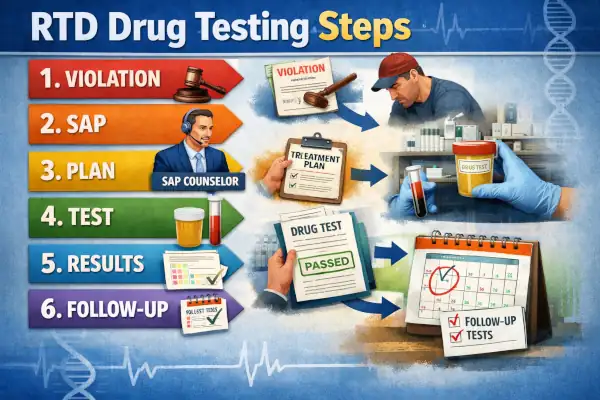
The 6-Step Clearinghouse RTD Process
The return-to-duty process involves the driver and employer working with a Substance Abuse Professional (SAP) to clear a violation through the FMCSA Clearinghouse. Here are the 6 steps:
Step 1: SAP Designated
Your employer provides you with a list of DOT-qualified SAPs. You select a SAP from that list or through your own research. This step places you in the RTD pipeline.
Step 2: SAP Request Sent
The SAP request is initiated in the Clearinghouse system. The clock starts here. Every day in prohibited status is a day you’re not earning.
Step 3: Initial SAP Assessment Completed
The designated SAP evaluates you and provides your employer with recommendations for education or treatment. The SAP must report completion by the close of business the day following the assessment. This may include:
- Education programs about substance abuse
- Treatment programs (outpatient or inpatient)
- Counseling sessions
- Other requirements based on your specific situation
Step 4: Driver Determined Eligible for RTD Test
After you complete the SAP’s prescribed plan, your SAP re-evaluates you to confirm compliance and establishes a follow-up testing plan. The SAP must report this determination by the close of business the following day. Once Step 4 is recorded in the Clearinghouse, you are eligible to proceed to your RTD test. This is where most Texas drivers get stuck — they’ve done the hard work but don’t know how to move forward.
Step 5: RTD Test with Negative Result — This Is Where We Come In
After completing the SAP’s plan, you take and must pass a directly observed DOT RTD drug test. This is where our $165 RTD Testing service delivers. We coordinate:
- Selection of convenient Texas testing locations — from Houston and Dallas-Fort Worth to San Antonio, Austin, El Paso, Midland-Odessa, and beyond
- Scheduling your directly observed RTD test
- All required DOT paperwork and compliance documentation
- Direct communication with testing facilities statewide
- Same-day Clearinghouse result processing once your negative result is confirmed
Once you pass the RTD test, you are no longer prohibited from performing safety-sensitive functions and can legally drive again. Your employer or C/TPA must report the negative result to the Clearinghouse within 3 business days.
Step 6: Follow-Up Testing Plan — The Long Game
You operate under the SAP’s follow-up testing plan. Key facts:
- Minimum of 6 unannounced, directly observed tests in the first 12 months
- Follow-up testing can extend up to 60 months based on SAP recommendations
- Your follow-up testing plan follows you between employers
- Step 6 is closed — and your Clearinghouse record cleared — when the final follow-up test is completed, typically 1–5 years after returning to work
⚠️ Critical Warning: Do Not Attempt to Order Your Own RTD Test
DOT regulations prohibit drivers from ordering their own RTD test. Even if you find a testing site willing to take your money, the test will not be valid. You will have wasted time and money — and potentially extended your prohibited status. All RTD tests and follow-up tests must be ordered by an employer or a Consortium/Third Party Administrator (C/TPA). This is a federal requirement under 49 CFR Part 40 — there are no exceptions, no workarounds, and no appeals.
Owner-operators and independent Texas drivers without a current employer need a C/TPA like our professional RTD Testing service to handle the process correctly and ensure your results count.
After RTD: Getting Back to Work in the Lone Star State
With your Clearinghouse status restored to “not prohibited,” you can immediately apply for driving positions, provide employers with proof of RTD completion, and resume commercial driving operations. Texas’s freight economy means those opportunities are waiting.
Texas Job Market Advantages for Returned Drivers:
- Port Drayage (Houston): Port Houston’s record container volumes create steady, well-paying demand for port-area trucking, with specialized drayage routes among the highest-paying local work in the state
- Permian Basin Energy: West Texas oilfield work remains one of the highest-paying CDL opportunities in the country — and they’re always hiring experienced drivers who have their paperwork straight
- NAFTA/Cross-Border Freight: Laredo is the busiest U.S.-Mexico land port of entry by trade value — experienced drivers with clean Clearinghouse records command premium rates on cross-border routes
- DFW Distribution: Dallas-Fort Worth added over 70 million square feet of warehouse space between 2022 and 2024, making it the fastest-growing logistics market in North America — demand for CDL drivers is relentless
- Agricultural Hauling: South Texas produce corridors, the Rio Grande Valley, and Panhandle grain routes offer seasonal premium rates for drivers who plan ahead
RTD Testing Locations Across the Lone Star State
Texas’s geographic scale — 268,000 square miles, 30+ million people — means testing location strategy matters. Our professional RTD Testing service helps you find a convenient, compliant location regardless of where in Texas you’re based.
Major Texas Testing Areas
Greater Houston Metro
Texas’s largest city and the nation’s largest port region. Testing locations serve:
- Central Houston: Multiple sites convenient to I-10, I-45, I-69, and the Ship Channel area
- West Houston / Katy: Serving Energy Corridor drivers and I-10 west operators
- North Houston / The Woodlands: Convenient to I-45 north and US-59 north corridors
- Pasadena / Baytown: Ideal for port-area and refinery-route drivers
- Sugar Land / Missouri City: Southwest Houston and Fort Bend County coverage
Dallas-Fort Worth Metroplex
The nation’s fastest-growing logistics market, with massive distribution and intermodal activity:
- Dallas: Serving I-20, I-30, I-35E, and LBJ Freeway corridor operators
- Fort Worth: Convenient to I-820, I-35W, and Alliance/AllianceTexas freight complex
- Irving / Las Colinas: DFW Airport and air freight logistics coverage
- Mesquite / Garland / Balch Springs: East Dallas distribution corridor
- Arlington / Grand Prairie: Mid-cities industrial and manufacturing routes
San Antonio
A critical junction on the NAFTA corridor and home to major military and manufacturing logistics:
- North San Antonio: Convenient to I-35 and I-410 north routes
- South San Antonio: Serving I-35 south toward Laredo and cross-border freight
- Loop 1604 / I-10 West: Distribution center coverage on the city’s growth corridors
Austin Metro
Texas’s fastest-growing city, with a booming tech and distribution sector:
- Central Austin: I-35 and MoPac corridor coverage
- Round Rock / Pflugerville: North Austin logistics hub area
- Kyle / Buda: South corridor serving I-35 south routes
West Texas and Permian Basin (Midland-Odessa)
The heart of oilfield trucking in America:
- Midland and Odessa: Serving Permian Basin oilfield operators directly
- Ector and Midland Counties: Full county coverage for Basin drivers
El Paso
The western gateway to Texas and a major US-Mexico crossing point:
- Central El Paso: I-10 and US-54 corridor coverage
- Santa Teresa / East El Paso: Border crossing area operators
Additional Coverage: Lubbock, Amarillo, Corpus Christi, Laredo, McAllen / Rio Grande Valley, Beaumont / Port Arthur / Orange, Tyler / Longview, and Waco. Our network of 10,000+ testing locations nationwide means no Texas driver is too remote to complete RTD quickly and compliantly.
Cost Analysis: Professional RTD Testing in Texas
What Your $165 Covers
$165 All-Inclusive Professional RTD Testing Service Includes:
- Complete DOT paperwork preparation and filing
- Strategic testing location selection (closest and most convenient to you)
- Appointment scheduling and coordination
- Direct communication with testing facilities
- Same-day Clearinghouse result processing
- Expert guidance throughout the entire process
- 35+ years of experience helping drivers return to work nationwide
Texas RTD Total Cost Breakdown
| Cost Component | Typical Range | Notes |
|---|---|---|
| SAP Initial Evaluation (Steps 1–3) | $400–$700 | National average ~$500; urban Texas (Houston, DFW) may trend higher |
| SAP Follow-Up Evaluation (Step 4) | Included or $100–$250 extra | Always ask upfront if the follow-up eval is included in the initial fee |
| Education / Treatment Program | $0–$5,000+ | Varies widely based on SAP’s recommendation; outpatient education may be minimal cost |
| TPA / RTD Testing Coordination (Step 5) | $165 | Kevin Shea, LPC — flat fee, no surprises |
| Testing Facility Fee | $50–$80 | Paid directly to the collection site; varies by location |
| Estimated Total (RTD only) | $215–$245 (Steps 4–5) | If your SAP has already cleared you at Step 4, this is your remaining cost |
ROI Calculation for Texas Drivers
Texas CDL drivers average $275–$500+ per day depending on route and specialty:
- Oilfield / Permian Basin: $350–$500+ per day including per diem
- Port drayage (Houston): $300–$420 per day
- Long-haul / OTR: $275–$375 per day
- Local delivery / distribution: $230–$320 per day
The math is simple: At $300/day lost earnings, every 3-week delay costs you $6,300+. Your $165 TPA investment — combined with fast, compliant scheduling — pays for itself the first morning you’re back behind the wheel.
⚠️ Texas Cannabis & DOT Drug Testing: What Every CDL Driver Must Know
Texas has no recreational marijuana legalization. Marijuana remains illegal under both Texas state law and federal law. Texas allows only a very limited medical marijuana program (the Compassionate Use Program, restricted to low-THC cannabis for specific qualifying medical conditions).
But here’s what’s causing confusion right now: On December 18, 2025, President Trump signed an Executive Order directing the rescheduling of marijuana from Schedule I to Schedule III under the federal Controlled Substances Act. Some drivers are reading headlines and assuming the rules for CDL drivers have changed.
They have not.
The U.S. Department of Transportation has issued a formal notice confirming that all DOT drug testing rules for safety-sensitive employees remain fully in effect. Rescheduling is not legalization. DOT’s zero-tolerance testing framework for CDL drivers is unchanged. Laboratories, MROs, and SAPs are required to continue following all existing procedures.
The bottom line for Texas CDL drivers:
- No state law or executive order protects your CDL if you test positive for marijuana
- A medical marijuana card — even under Texas’s Compassionate Use Program — is not a valid defense for a positive DOT drug test
- CBD products can trigger positive results if they contain more than 0.3% THC; the FDA does not certify THC levels on CBD labels
- Delta-8 THC can and does show up on standard DOT drug screens
If a positive THC result has already put you in prohibited status, the path forward is the RTD process — not waiting for federal policy to catch up.
Timeline Expectations for Texas Drivers
How fast can you get back on the road? If your SAP has already cleared you as eligible (Step 4 recorded in the Clearinghouse), here’s a realistic timeline:
| Phase | Typical Timeline | What Happens |
|---|---|---|
| Contact TPA & Confirm Eligibility | Day 1 | Verify Step 4 is recorded; complete TPA paperwork |
| Testing Location Identified & Scheduled | Day 1–2 | Convenient location selected; appointment confirmed (48-hour scheduling guarantee) |
| RTD Test Completed | Day 2–4 | Directly observed collection at certified site |
| Lab Processing | 1–3 business days | Certified lab processes specimen; MRO reviews result |
| Clearinghouse Updated | Within 3 business days of negative result | Status changes to “not prohibited”; Texas DPS automatically notified |
| Back on the Road | 3–7 business days total | Fully legal to perform safety-sensitive functions |
Delays typically come from incomplete SAP documentation, unverified Step 4 status in the Clearinghouse, or choosing to navigate the process without professional coordination. Starting with a qualified TPA eliminates all three risk factors.
Ready to Get Back to Work? Here’s What to Do Next
Every day you wait is another $300+ out of your pocket. Here’s how to move:
- Confirm your SAP has reported Step 4 in the FMCSA Clearinghouse (driver eligible for RTD test)
- Contact Kevin Shea, LPC — 35+ years of experience, nationwide TPA services, $165 flat fee
- Get scheduled within 48 hours — guaranteed
- Pass your test — directly observed, fully compliant, Clearinghouse-reported same day
- Drive
→ Complete the RTD Scheduling Form
Call/Text: (843) 327-4444
Email: ksheatpa@gmail.com
Available Monday–Sunday, 8:00 AM – 8:00 PM
If I can’t help you get scheduled within 48 hours, full refund guaranteed.
Frequently Asked Questions: Texas Return to Duty Drug Testing
What is Return-to-Duty (RTD) testing for Texas CDL drivers?
RTD testing is the federally required process a CDL driver must complete after a DOT drug or alcohol violation. It includes a Substance Abuse Professional (SAP) evaluation, compliance with the SAP’s recommendations, a directly observed RTD test with a negative result, and follow-up testing. Once you pass the RTD test, your Clearinghouse status changes to “not prohibited” and you can legally drive again.
How does Texas DPS handle FMCSA Clearinghouse violations?
Texas DPS is fully integrated with the FMCSA Drug and Alcohol Clearinghouse. As of June 30, 2024, Texas DPS checks the Clearinghouse before issuing any commercial license and must remove commercial driving privileges for drivers with a prohibited status. Once your Clearinghouse status updates to “not prohibited” after a negative RTD test, Texas DPS is automatically notified — no additional paperwork required on your end.
How long does RTD testing take in Texas?
If your SAP has already cleared you as eligible (Step 4 recorded in the Clearinghouse), the RTD test can typically be scheduled and completed within 2–4 days, with Clearinghouse reporting finalized within 3–7 business days total. Working with a qualified TPA like our service ensures there are no documentation delays or administrative errors that extend your prohibited status.
Can I order my own RTD test in Texas?
No. DOT regulations prohibit drivers from ordering their own RTD test. Even if a testing site accepts payment, the test will not be valid and will not count toward your return to duty process. All RTD tests must be ordered by an employer or a Consortium/Third Party Administrator (C/TPA). Owner-operators and independent Texas drivers must work with a C/TPA to ensure valid, Clearinghouse-reported testing.
Does Texas marijuana law or the new federal rescheduling executive order protect CDL drivers?
No. Texas has no recreational marijuana law. While Texas allows a very limited medical marijuana program, no state law protects CDL drivers from DOT drug testing consequences. The December 2025 executive order directing marijuana rescheduling to Schedule III does not change DOT drug testing rules — the Department of Transportation has formally confirmed all existing regulations remain fully in effect. A positive marijuana test is still a DOT violation regardless of state law or federal policy changes.
How much does RTD testing cost in Texas?
Professional RTD Testing coordination is $165 (TPA fee). The testing facility collection fee is additional, typically $50–$80 depending on location. That total of approximately $215–$245 covers everything from Step 5 scheduling through Clearinghouse reporting — assuming your SAP has already completed Steps 1–4.
Where can I take an RTD test in Texas?
Testing locations are available throughout Texas, including Houston, Dallas-Fort Worth, San Antonio, Austin, El Paso, Midland-Odessa, Lubbock, Amarillo, Corpus Christi, Laredo, McAllen, and beyond. Our service has access to 10,000+ collection sites nationwide, ensuring a convenient location regardless of where in Texas you’re located.
What is a directly observed RTD test?
Yes — your RTD test and all follow-up tests must be directly observed. This means a qualified observer watches the collection process. This is a federal requirement under 49 CFR Part 40 that applies to all return-to-duty and follow-up tests with no exceptions. Our TPA service coordinates directly observed collections at all sites to ensure full compliance.
What happens after my negative RTD test?
Your employer or C/TPA reports the negative result to the FMCSA Clearinghouse within 3 business days. Once posted, your status changes from “prohibited” to “not prohibited,” restoring your eligibility to perform safety-sensitive functions. Texas DPS is automatically notified. You can immediately begin driving again and must complete your SAP’s follow-up testing plan (minimum 6 unannounced tests in the first 12 months).
What if I’m an owner-operator in Texas without an employer?
Owner-operators need a Consortium/Third Party Administrator (C/TPA) to manage their RTD testing — federal regulations require a third party to order and report the test results. Our professional RTD Testing service fulfills this requirement and handles all Clearinghouse reporting on your behalf. This is standard for independent Texas operators.
Can I appeal my SAP’s decision or get a second SAP opinion?
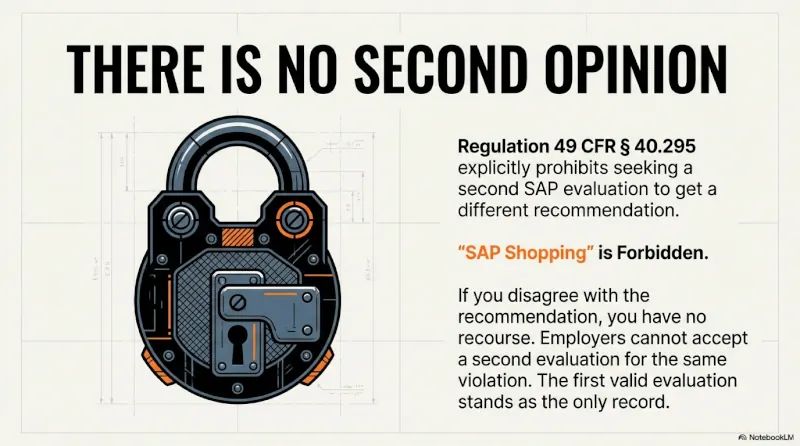
No. Under 49 CFR Part 40, §40.295, you cannot appeal a SAP’s decision, and second SAP opinions are prohibited once the evaluation has started. Only the SAP can change their own recommendations. If you have a new violation, you may choose a different SAP for that new case. For questions about your specific situation, call Kevin Shea directly at (843) 327-4444.
