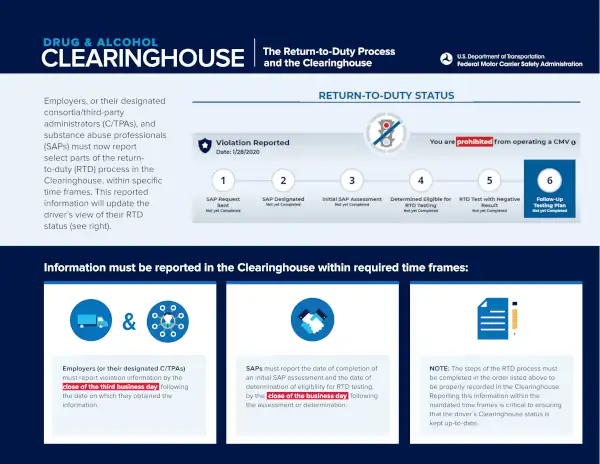
You’ve completed treatment. You’ve done everything your Substance Abuse Professional asked. Now you’re sitting at Step 4 in the Clearinghouse, waiting—and wondering why you still can’t schedule your own Return to Duty test.
Here’s the reality that catches most drivers off guard: your SAP isn’t just a box to check on the way back to your CDL. They’re the gatekeeper who determines when you’re eligible for your RTD test, what your follow-up testing looks like for the next 1-5 years, and whether your documentation will hold up when a new employer runs your Clearinghouse query. With over 180,000 drivers currently stuck in “prohibited” status nationwide—and less than 17% ever completing the RTD process—understanding the SAP’s role could mean the difference between getting back behind the wheel in days versus staying sidelined for months.
Table of Contents
- What Makes Someone a Qualified SAP
- The Initial Evaluation: What Your SAP Is Really Looking For
- From Treatment to Clearance: The Follow-Up Evaluation
- How the SAP Authorizes Your RTD Test
- The Follow-Up Testing Plan That Follows You for Years
- What You Can’t Do (No Matter How Frustrating)
- FAQ
What Makes Someone a Qualified SAP
Not everyone with a counseling degree can evaluate you. Federal regulations under 49 CFR Part 40, Subpart O spell out exactly who qualifies as a DOT Substance Abuse Professional.
Your SAP must hold one of six specific credentials: licensed physician (MD or DO), licensed psychologist, licensed social worker, licensed employee assistance professional, state-licensed marriage and family therapist, or a certified drug and alcohol counselor through organizations like NAADAC or IC&RC.
But credentials alone aren’t enough. Every SAP must complete roughly 12 hours of specialized DOT training covering nine required topics, pass a comprehensive exam with at least 80% accuracy, and maintain 12 continuing education hours every three years. They’re also required to stay current by subscribing to DOT’s ODAPC email updates.
Here’s the part that surprises most drivers: according to § 40.291(b), your SAP is “not an advocate for the employer or employee.” Their job is protecting public safety—not getting you back to work as fast as possible. Understanding this distinction helps set realistic expectations for what comes next.
The Initial Evaluation: What Your SAP Is Really Looking For
Your first SAP evaluation must be conducted face-to-face—either in-person or via video telehealth with real-time audio and visual interaction. Phone-only evaluations are prohibited under DOT rules.
During this assessment, which typically costs $250-$500, your SAP conducts a comprehensive clinical evaluation. They’re examining your complete drug and alcohol use history: when it started, how often, which substances, and what problems resulted. They’ll review your psychosocial history, screen for depression (which affects over 50% of people with substance use issues), assess your current mental status, and observe everything from your physical appearance to your non-verbal communication.
Here’s what the regulations require that many drivers don’t realize: your SAP must recommend education and/or treatment for every single driver. There’s no scenario where a DOT-qualified SAP evaluates you and says “you’re fine, go take your test.” Per § 40.293, every driver receives some form of recommendation.
What your SAP explicitly cannot consider? Claims that the test was wrong. Arguments about “medical marijuana” or hemp products. Poppy seed explanations. Job stress as justification. These defenses are specifically excluded from SAP consideration—regardless of how valid they might seem to you.
| What the SAP Evaluates | What the SAP Cannot Consider |
|---|---|
| Drug/alcohol use history | Claims the test was inaccurate |
| Mental health status | Medical marijuana arguments |
| Treatment history | Hemp/CBD product exposure |
| Current functioning | Poppy seed consumption |
| Risk assessment | Job stress as mitigation |
From Treatment to Clearance: The Follow-Up Evaluation
After completing your prescribed education or treatment, you return to the same SAP for a follow-up evaluation. You cannot switch SAPs mid-process—the professional who conducted your initial evaluation is the only one who can clear you for RTD testing.
This follow-up evaluation, sometimes included in the initial fee or an additional $100-$200, involves two critical components. First, your SAP contacts your treatment or education provider directly. They’re not just checking that you showed up—they’re reviewing written reports, discussing your progress, evaluating your prognosis, and assessing how actively you participated.
Second, they conduct another face-to-face clinical interview with you. The question they’re answering: have you demonstrated “successful compliance” with their recommendations?
Here’s an important nuance most drivers miss: successful compliance doesn’t always mean 100% completion of everything recommended. According to DOT guidance, a SAP can determine you’re ready for RTD testing if you’ve demonstrated appropriate clinical progress—even if aftercare or continuing treatment remains. However, if you’re in an inpatient or day-treatment program, you must complete it before this follow-up can occur.
If you haven’t demonstrated successful compliance, your SAP contacts your employer (or former employer) to determine whether they’ll authorize additional time. Without that determination, you remain in prohibited status indefinitely.
How the SAP Authorizes Your RTD Test
Once your SAP determines successful compliance, they don’t schedule your test. They issue documentation authorizing your employer—or for owner-operators, your Third Party Administrator (TPA)—to proceed.
Your SAP sends a Follow-Up Evaluation Report directly to your employer’s Designated Employer Representative (DER). This report, which must be on the SAP’s own letterhead per § 40.311, includes:
- Your identifying information and the specific violation
- A synopsis of your treatment/education plan
- Names and dates of programs completed
- The SAP’s clinical assessment of your participation
- Their determination of successful compliance
- Continuing care recommendations
- The follow-up testing plan
That last item—the follow-up testing plan—comes with a critical requirement: your SAP must instruct your employer to keep it confidential. You will never know when your follow-up tests are coming. That unpredictability is intentional and required by regulation.
This is the handoff point. Your employer or TPA now has authorization to send you for your directly observed RTD test. For owner-operators and drivers between jobs, this is where a C/TPA like professional RTD Testing services becomes essential—DOT regulations prohibit drivers from ordering their own RTD test, even after SAP clearance.
The Follow-Up Testing Plan That Follows You for Years
Your SAP doesn’t just clear you for one test. They create a follow-up testing plan that becomes one of the most significant long-term consequences of your violation.
Under § 40.307, the minimum requirement is 6 unannounced, directly observed tests in the first 12 months after returning to safety-sensitive duties. But your SAP has authority to require more tests during this period—and can extend testing for an additional 48 months. That’s up to 60 months (5 years) total of follow-up testing.
| Follow-Up Testing Requirements | Details |
|---|---|
| Minimum tests in Year 1 | 6 unannounced, directly observed |
| Maximum testing period | 60 months (5 years) |
| Testing type | Drugs, alcohol, or both (SAP determines) |
| Observation requirement | All follow-up tests are directly observed |
| Plan transferability | Follows you to any new employer |
The SAP has sole authority over this plan. If your evaluation revealed poly-substance use, expect testing for both drugs and alcohol—even if your original violation involved only one. And here’s what makes this consequential for your career: this plan “follows the employee.” Change jobs mid-plan, and your new employer must complete the remaining tests.
What You Can’t Do (No Matter How Frustrating)
The SAP process generates more driver frustration than almost any other part of the RTD journey. Understanding the boundaries upfront prevents costly mistakes.
You cannot get a second opinion. Per § 40.295, once a qualified SAP evaluates you, no employer can rely on any subsequent evaluation for the same violation. Choose your initial SAP carefully—they’re your SAP for the duration.
You cannot appeal SAP decisions. There’s no formal process to dispute treatment recommendations or follow-up testing plans. The same SAP can modify recommendations based on new clinical information, but you cannot override their judgment with a different professional.
You cannot order your own RTD test. Even after SAP clearance, federal regulations prohibit drivers from ordering their own Return to Duty test. Some testing sites will take your money anyway—but that test won’t count, won’t be valid, and won’t be reported to the Clearinghouse. All RTD tests must be ordered by an employer or C/TPA.
You cannot see your follow-up testing schedule. The timing remains confidential to maintain unpredictability. This isn’t your employer being difficult—it’s a federal requirement.
The SAP process represents DOT’s mechanism for balancing public safety with driver rehabilitation. It’s not designed to be easy, and it’s not designed to be fast. But it’s navigable—especially with 35+ years of experience guiding you through.
Every day you wait costs you $300+ in lost earnings. If you’re stuck at Step 4 and ready for your RTD test, professional TPA services can get you scheduled within 48 hours and results entered into the Clearinghouse the same day.
Ready to complete Step 5 and get back behind the wheel?
📞 Call/Text: (843) 327-4444
📧 Email: ksheatpa@gmail.com
🔗 Schedule My Return-to-Duty Test Now
Frequently Asked Questions
What is a Substance Abuse Professional (SAP) and why do I need one?
A SAP is a DOT-qualified professional—such as a licensed counselor, psychologist, or physician—who evaluates CDL drivers after a drug or alcohol violation. Under 49 CFR Part 40, you cannot take your Return to Duty test or return to safety-sensitive work without completing both SAP evaluations (initial and follow-up). The SAP determines what treatment or education you need and when you’re eligible for RTD testing.
Can I get a second opinion if I disagree with my SAP’s recommendations?
No. Federal regulations under § 40.295 prohibit second opinions once a qualified SAP has evaluated you. Employers cannot rely on any subsequent evaluation for the same violation. The same SAP can modify their recommendations based on new clinical information, but you cannot dispute their findings with a different professional.
How long does the SAP process take before I can get my RTD test?
Timelines vary significantly based on your individual situation. If your SAP recommends education-only, you might complete requirements in 2-4 weeks. If treatment is recommended, it could take several weeks to months. Once your SAP determines successful compliance and clears you (Step 4 in Clearinghouse), scheduling and completing the RTD test typically takes 3-7 business days with professional TPA services.
What happens during the SAP follow-up evaluation?
Your SAP conducts another face-to-face interview and contacts your treatment/education provider to review your progress. They’re determining whether you’ve demonstrated “successful compliance” with their recommendations. If yes, they issue documentation authorizing your employer or TPA to schedule your RTD test and create your follow-up testing plan.
How many follow-up tests will I have after my RTD test?
The minimum under DOT regulations is 6 unannounced, directly observed tests in the first 12 months after returning to work. Your SAP can require more tests and can extend the testing period up to 60 months (5 years) total. The exact plan depends on your clinical evaluation and is confidential—you won’t know when tests are coming.
Can I order my own Return to Duty test after my SAP clears me?
No. DOT regulations prohibit drivers from ordering their own RTD test. Even if a testing site takes your money, the test will not be valid and won’t count toward your return to duty process. All RTD and follow-up tests must be ordered by an employer or Consortium/Third Party Administrator (C/TPA).
