Your CDL career in Louisiana hangs in the balance. One failed drug test has put you in Clearinghouse limbo, and every day you’re not driving costs you $300+ in lost earnings. But here’s what most Pelican State drivers don’t know: the return to duty process doesn’t have to be a maze of confusion and costly delays.
With Louisiana serving as America’s premier gateway to the nation’s heartland—home to five of the country’s twelve busiest ports by total tonnage, over 306,000 energy-sector jobs, and 934 miles of interstate highways connecting the Gulf Coast to every major market—Louisiana drivers are essential to the nation’s supply chain. When a positive drug test threatens your CDL career, knowing the exact steps to get back behind the wheel quickly and compliantly can mean the difference between financial disaster and career recovery.
The stakes couldn’t be higher. As of November 18, 2024, new federal regulations mean that drivers with “prohibited” status in the DOT Clearinghouse will have their CDL automatically downgraded by the Louisiana Office of Motor Vehicles. With over 180,000 CDL holders nationwide currently in “prohibited” status as of early 2025, time is running out for drivers to complete their return to duty process.
This comprehensive guide cuts through the confusion with insider knowledge from 35+ years of helping Louisiana drivers with their RTD Testing needs. You’ll discover the exact steps, avoid costly mistakes, understand Louisiana’s unique transportation landscape, and get back to earning your living on the Pelican State’s highways.
Why Louisiana RTD is Different from Other States
Louisiana’s return to duty landscape presents unique opportunities and challenges that drivers in other states may not face. The state’s unparalleled position at the crossroads of America’s water, rail, and highway freight networks creates both urgency and extraordinary opportunity for drivers completing the RTD process.
Louisiana’s Port System: America’s Gateway to the World
Louisiana is home to the most strategically vital port system in America. The Port of South Louisiana ranks as the largest tonnage port in the Western Hemisphere, handling over 248 million short tons of cargo in 2023—that’s more than 50% of all U.S. grain exports passing through its 54-mile stretch along the Mississippi River between New Orleans and Baton Rouge.
The Port of New Orleans moved 133,845 TEUs in the third quarter of fiscal year 2024 alone—a 19% year-over-year increase and a record quarter. What makes Port NOLA truly exceptional: it’s the only deep-water port in the United States connected to all six Class I railroads through the New Orleans Public Belt Railroad, creating unmatched intermodal efficiency for freight haulers.
According to the U.S. Army Corps of Engineers, Louisiana is home to five of America’s twelve busiest ports by total tonnage: South Louisiana (No. 2), New Orleans (No. 6), Greater Baton Rouge (No. 8), Lake Charles (No. 10), and Plaquemines (No. 12). This freight volume translates to immediate earning opportunities for drivers who can get back on the road quickly.
Louisiana’s Highway Network: The Crossroads of America
Louisiana’s 934-mile interstate highway system forms a critical freight corridor connecting the Gulf Coast to every major U.S. market. The state’s major routes include:
- I-10: The primary east-west artery spanning 274 miles across Louisiana, connecting Texas to Mississippi through Lake Charles, Lafayette, Baton Rouge, and New Orleans—one of the busiest commercial trucking corridors in the southern United States
- I-12: A crucial northern bypass of New Orleans connecting Baton Rouge to Slidell, providing an alternative route that reduces congestion and offers faster transit times
- I-20: East-west route through northern Louisiana connecting Shreveport to Mississippi and beyond, serving the Texas-to-Atlanta corridor
- I-49: North-south corridor running from Lafayette through Alexandria to Shreveport, connecting central Louisiana to major markets
- I-55: North-south route connecting southeastern Louisiana to Mississippi, serving as a crucial Gulf Coast to Midwest corridor
Freight traffic comprises approximately one-third of the volume along Interstate 10 between Lafayette and the Atchafalaya Basin Bridge—one of the heaviest commercial truck traffic segments in the region. Every day you’re sidelined means missing out on lucrative port drayage, petrochemical hauling, and cross-country routes through Louisiana’s strategic network.
Energy Sector Powerhouse: Petrochemical and LNG Opportunities
Louisiana’s energy sector remains a dominant economic force, generating 25% of the state’s economy with over 306,750 energy-related jobs and $25.5 billion in annual earnings, according to a 2025 study by the Louisiana Mid-Continent Oil and Gas Association. The River Corridor alone—running between Baton Rouge and New Orleans—supports 134,654 total energy jobs.
For CDL drivers, this translates to high-paying tanker, hazmat, and specialized freight opportunities throughout the state. The Port of Lake Charles has moved into the top ten busiest U.S. deepwater ports, driven largely by LNG exports from the Cameron LNG facility. Drivers with hazmat and tanker endorsements who complete RTD quickly can tap into this premium freight market.
Louisiana OMV Clearinghouse Integration
The Louisiana Office of Motor Vehicles is fully integrated with the FMCSA Clearinghouse system. As of November 18, 2024, the OMV must downgrade or disqualify a driver with a “prohibited” Clearinghouse status within 60 days of notification. The good news: once your Clearinghouse status changes to “not prohibited” after completing the RTD process, the Louisiana OMV is automatically notified—no additional paperwork required on your end.
Your Step-by-Step Louisiana Return to Duty Roadmap
Navigating Louisiana’s return to duty process successfully requires understanding both federal requirements and state-specific considerations. Here’s your complete roadmap to getting back behind the wheel.
Pre-RTD Requirements: Getting Your Documentation Ready
Before you can begin return to duty testing, you must complete all Substance Abuse Professional (SAP) requirements. This means:
SAP Evaluation and Treatment Completion: Your SAP must provide documentation confirming you’ve completed all required education or treatment programs. This isn’t just a certificate—it’s detailed paperwork that meets federal DOT standards under 49 CFR Part 40.
Louisiana-Specific Documentation: While the federal process is standardized, Louisiana’s employment landscape requires attention to detail. Ensure all documentation includes:
- Complete SAP evaluation reports
- Treatment completion certificates
- Return to duty recommendations
- Follow-up testing protocols
Payment Preparation: Professional RTD Testing services in Louisiana cost $165 for comprehensive coordination—a small investment to ensure your test is valid and properly reported to the Clearinghouse.
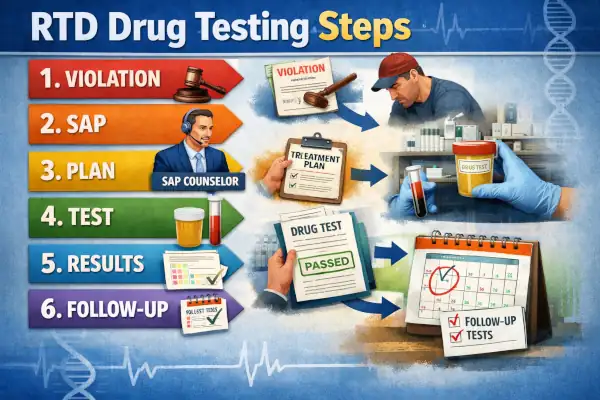
The 6-Step Clearinghouse RTD Process
The return-to-duty process involves the driver and employer working with a Substance Abuse Professional (SAP) to clear a violation through the FMCSA Clearinghouse. Here are the 6 steps:
Step 1: Driver Violation Occurs
A CDL driver tests positive for drugs/alcohol or refuses a test, creating a violation record in the Clearinghouse. This violation places the driver in “prohibited” status, meaning they cannot perform safety-sensitive functions until the RTD process is complete.
Step 2: Driver Connects with a SAP
The driver must contact a Substance Abuse Professional (SAP)—a DOT-certified expert—for evaluation and education. The SAP will assess your situation and determine what treatment or education you need. The national average for SAP services in 2025 is $500. Find a qualified SAP in Louisiana at www.saplist.com.
Step 3: SAP Makes Recommendations & Driver Completes Program
The SAP prescribes a treatment and/or education plan, which the driver must complete. This may include:
- Education programs about substance abuse
- Treatment programs (outpatient or inpatient)
- Counseling sessions
- Other requirements based on your specific situation
Once completed, the SAP will clear you to proceed to RTD Testing (Step 4 in the Clearinghouse).
Step 4: Driver Determined Eligible for RTD Test
After completing the SAP’s recommendations, the SAP conducts a follow-up evaluation to confirm compliance and reports your eligibility for RTD testing to the Clearinghouse. This is where many drivers get stuck—you’ve done the hard work, but you need a C/TPA (Consortium/Third Party Administrator) to order your RTD test.
Step 5: Negative Return-to-Duty (RTD) Test
This is where our $165 RTD Testing service comes in. We coordinate:
- Selection of convenient Louisiana testing locations
- Scheduling your directly observed RTD test
- All required DOT paperwork and compliance documentation
- Same-day Clearinghouse reporting upon negative result
Major Louisiana Testing Areas Covered:
- New Orleans Metro: Multiple locations serving Orleans, Jefferson, St. Tammany, and St. Bernard parishes—convenient to port operations and I-10 corridor
- Baton Rouge: Serving East Baton Rouge, West Baton Rouge, Ascension, and Livingston parishes—the capital city and petrochemical corridor hub
- Lafayette: Central Louisiana’s Acadiana region, serving the I-10 and I-49 intersection
- Shreveport-Bossier City: Northwest Louisiana hub serving the I-20 corridor and Texas border traffic
- Lake Charles: Southwest Louisiana’s energy hub and I-10 gateway to Texas
- Monroe: Northeast Louisiana coverage serving the I-20 corridor
- Alexandria: Central Louisiana hub at the crossroads of major state highways
- Houma-Thibodaux: Bayou Region coverage serving offshore energy sector drivers
Step 6: Follow-Up Testing Plan Begins
After a negative RTD test, you can return to safety-sensitive functions. However, you’ll remain under a follow-up testing plan established by your SAP—minimum 6 unannounced, directly observed tests in the first 12 months, with the plan potentially extending up to 60 months. This follow-up testing plan follows you between employers.
Louisiana Cannabis Laws and Your CDL
Louisiana’s evolving cannabis landscape creates a critical legal trap that every CDL driver must understand. The state’s medical marijuana program, while legal under state law, offers zero protection for commercial drivers under federal DOT regulations.
Current Louisiana Cannabis Status:
- Medical Marijuana: Legal since 2015 (first dispensaries opened in 2019). The Louisiana Department of Health now regulates 23 licensed cannabis retailers, with a cap of 30 statewide.
- Recreational Marijuana: Still illegal. Possession of small amounts (under 14 grams) was decriminalized in 2021, reducing penalties to a $100 fine for first offense.
- Hemp-Derived THC: New regulations as of January 1, 2025 (Act 752) tightened restrictions on hemp-derived THC products, banning flower products and sale to anyone under 21.
The Federal Override: What Every Louisiana CDL Driver Must Know
Here’s the critical reality: Federal DOT regulations supersede all Louisiana state cannabis laws for CDL drivers. Under 49 CFR Part 40, marijuana remains a Schedule I controlled substance with zero tolerance for safety-sensitive transportation employees.
This means:
- A valid Louisiana medical marijuana recommendation provides no legal protection for CDL holders
- Any positive marijuana test result—regardless of Louisiana prescription status—triggers Clearinghouse reporting
- Louisiana employers can terminate CDL drivers for positive marijuana tests even with a valid medical card
- The Medical Review Officer (MRO) cannot verify a marijuana positive as legitimate for DOT tests, even with a Louisiana medical marijuana recommendation
Louisiana does NOT have explicit employment protections for medical marijuana patients. Employers may maintain drug-free workplace policies and refuse to hire or terminate based on positive drug tests—including for state-legal medical marijuana use.
Bottom Line for Louisiana CDL Drivers: Regardless of Louisiana’s state laws, if you hold a CDL and want to keep driving commercially, marijuana use is not an option. Period. The same applies whether you’re hauling containers out of Port NOLA, tanking chemicals along the River Corridor, or running I-10 freight to Texas.
Louisiana RTD Cost Breakdown
Understanding the true costs of return to duty helps you budget effectively and avoid surprises. Here’s a realistic breakdown of what Louisiana drivers typically spend:
| Cost Component | Louisiana Estimate | Notes |
|---|---|---|
| SAP Initial Evaluation | $400-$600 | National average is $500. Urban areas (New Orleans, Baton Rouge) trend higher |
| Education/Treatment Program | $200-$2,000+ | Varies widely based on SAP recommendations; outpatient education on lower end, intensive treatment higher |
| SAP Follow-Up Evaluation | $0-$200 | Some SAPs include in initial fee; always ask upfront |
| RTD Testing Service (C/TPA) | $165 | Our comprehensive service fee |
| RTD Collection Site Fee | $50-$80 | Paid directly to testing facility |
| Follow-Up Tests (6 minimum) | $300-$600 | Typically $50-100 per test over first year |
| TOTAL ESTIMATED RANGE | $1,115-$3,645+ | Treatment intensity is the biggest variable |
Hidden Costs of DIY Approaches:
Do not attempt to order your own RTD test. DOT regulations prohibit drivers from ordering their own return to duty test. Even though you may find a testing site willing to take your money, the test will not be valid and will not count toward your return to duty process. You will have wasted time and money—and potentially delayed your career recovery by weeks.
Other pitfalls to avoid:
- Documentation errors: $200-500 in retest fees
- Scheduling delays: $300+ per day in lost Louisiana wages
- Clearinghouse reporting issues: Extended prohibition status
- Using out-of-state SAPs without proper licensure: Potentially invalid treatment documentation
Important SAP Selection Advice: Be cautious of using a SAP outside your state of residence. Legally, they cannot provide SAP services unless they are licensed in Louisiana. SAPs may claim they can provide services in all 50 states because they’re “nationally certified”—but certification is not the same as licensure. DOT is clear that SAPs must be approved by each state where they offer services. The best way to find a qualified SAP in Louisiana is www.saplist.com.
Louisiana RTD Timeline Expectations
Realistic timeline planning helps you manage expectations and minimize lost income. Here’s what Louisiana drivers typically experience:
| Phase | Duration | Key Variables |
|---|---|---|
| SAP Initial Evaluation | 1-7 days | Appointment availability; rural Louisiana areas may have longer waits |
| Treatment/Education Program | 1-12 weeks | SAP recommendations; ranges from brief education to intensive treatment |
| SAP Follow-Up Evaluation | 1-7 days | Scheduling; must document treatment completion |
| RTD Test Scheduling | 1-3 days | Our 48-hour scheduling guarantee for Louisiana |
| Lab Results & Clearinghouse Update | 2-5 days | Lab processing time; we report same-day upon negative result |
| TOTAL (after SAP clearance) | 3-10 days | From Step 4 to driving legally |
Louisiana-Specific Timeline Factors:
- Urban areas (New Orleans, Baton Rouge, Shreveport): More SAP availability, more testing locations, typically faster scheduling
- Rural parishes: May require travel to metro areas for testing; plan accordingly
- Hurricane season (June-November): Weather disruptions can affect testing site availability; schedule promptly when cleared
- Energy sector timing: Petrochemical plant turnarounds and offshore rotations create hiring surges—completing RTD before these periods maximizes opportunity
Louisiana Employment Recovery After RTD
Completing your RTD test is the finish line for returning to legal driving status—but it’s also the starting line for rebuilding your career. Louisiana’s diverse freight economy offers multiple pathways back to full employment.
Louisiana’s Employment Landscape for CDL Drivers
According to the Bureau of Labor Statistics, the median salary for truck drivers in Louisiana was $48,770 in 2024, with top earners reaching $71,540+. Owner-operators can earn $120,000-$160,000 annually depending on freight contracts and operating costs.
Key Louisiana Freight Sectors Hiring:
- Port Drayage: With five of the nation’s top twelve ports, container and bulk freight opportunities are abundant. Port of New Orleans intermodal rail volumes grew 15%+ in 2024.
- Petrochemical/Tanker: The River Corridor supports 134,654 energy jobs. Hazmat and tanker endorsement holders are in high demand.
- LNG/Energy: Lake Charles area LNG exports continue expanding. Specialized transport opportunities pay premium rates.
- Agricultural: Louisiana’s sugarcane harvest (October-January) and rice production create seasonal freight surges with bonus pay.
- Construction/Heavy Haul: Ongoing infrastructure projects including the Louisiana International Terminal development create consistent demand.
Getting Hired After RTD:
Be prepared to discuss your violation honestly with potential employers. Many Louisiana carriers understand that one mistake shouldn’t end a career. What matters is:
- Completed RTD process with proper documentation
- Clean Clearinghouse status showing “not prohibited”
- Commitment to compliance demonstrated through completed follow-up testing
- Clean driving record otherwise
Some carriers specialize in second-chance hiring and understand the RTD process. Regional and local carriers may be more flexible than large national fleets for initial post-RTD employment.
Frequently Asked Questions: Louisiana RTD
What is Return-to-Duty (RTD) testing for Louisiana CDL drivers?
RTD testing is the federally required process a CDL driver must complete after a DOT drug or alcohol violation. It includes a Substance Abuse Professional (SAP) evaluation, compliance with the SAP’s recommendations, a directly observed RTD test with a negative result, and follow-up testing. Once you pass the RTD test, your Clearinghouse status changes to “not prohibited” and you can legally drive again.
How does the Louisiana Office of Motor Vehicles handle Clearinghouse violations?
The Louisiana OMV is fully integrated with the FMCSA Clearinghouse. When you’re placed in prohibited status, the OMV is automatically notified and must downgrade or disqualify your CDL within 60 days. Once you complete the RTD process and your status changes to “not prohibited,” the OMV is automatically notified—no additional paperwork required on your end.
Can I use my Louisiana medical marijuana card and keep my CDL?
No. Federal DOT regulations supersede Louisiana state cannabis laws for CDL drivers. Marijuana remains a Schedule I controlled substance under federal law with zero tolerance. A positive marijuana test will trigger Clearinghouse reporting regardless of any Louisiana medical marijuana recommendation. Louisiana also has no employment protections for medical marijuana patients.
How long does it take to complete RTD in Louisiana?
Timelines vary based on your situation. The treatment/education phase (determined by your SAP) takes the longest—typically 1-12 weeks. Once your SAP clears you as eligible (Step 4 in the Clearinghouse), scheduling and completing the observed RTD test plus Clearinghouse reporting can typically be finished within 3-7 business days.
Can I order my own RTD test in Louisiana?
No. DOT regulations prohibit drivers from ordering their own RTD test. Even if a testing site takes your money, the test will not be valid and won’t count toward your return to duty process. All RTD tests and follow-up tests must be ordered by an employer or a Consortium/Third Party Administrator (C/TPA). Owner-operators and independent drivers must work with a C/TPA to ensure valid, compliant testing.
Where can I take an RTD test in Louisiana?
There are DOT-collection sites throughout Louisiana, including New Orleans, Baton Rouge, Lafayette, Shreveport-Bossier City, Lake Charles, Monroe, Alexandria, and Houma-Thibodaux. Professional TPA services have access to over 10,000 testing locations nationwide, ensuring convenient scheduling regardless of your location in Louisiana.
What happens in the FMCSA Clearinghouse after a negative RTD result?
Your employer or C/TPA reports the negative RTD result to the FMCSA Clearinghouse within 3 business days. Once posted, your status changes from “prohibited” to “not prohibited,” restoring your eligibility to perform safety-sensitive functions. The Louisiana OMV is automatically notified of this change.
How many follow-up tests are required after RTD?
The SAP sets the follow-up testing plan. DOT requires a minimum of six unannounced, directly observed tests in the first 12 months, and the plan can extend up to 60 months total. This follow-up testing plan follows you between employers—it’s tied to you, not your job.
What do the November 2024 CDL downgrade rules mean for Louisiana drivers?
As of November 18, 2024, the Louisiana OMV must downgrade or disqualify a driver with a “prohibited” Clearinghouse status within 60 days. To reinstate commercial privileges, you must complete the RTD process so your status becomes “not prohibited.” The OMV will then automatically allow reinstatement of your CDL.
How much does RTD Testing cost in Louisiana?
Professional RTD Testing services cost $165, which includes all coordination, paperwork, and Clearinghouse reporting. The testing facility fee is additional (typically $50-80). The total RTD process—including SAP evaluations, treatment, and testing—typically ranges from $1,115-$3,645+, with treatment intensity being the biggest cost variable.
Can I appeal my SAP’s decision or get a second opinion?
No. Once a SAP begins your evaluation, you cannot get a second opinion—this is prohibited under 49 CFR Part 40, § 40.295. Only your SAP can modify their recommendations. If you haven’t started the evaluation process and want to switch SAPs, you must petition DOT to remove you from that SAP’s dashboard—a process that takes 30-90 days, during which you cannot move forward.
What if I’m an owner-operator without an employer in Louisiana?
Owner-operators need a Consortium/Third Party Administrator (C/TPA) to manage their RTD Testing, as federal regulations require a third party to order and report the test results. Professional RTD Testing services fulfill this requirement and handle all Clearinghouse reporting on your behalf—essential for Louisiana’s many independent truckers serving the port system and energy sector.
What are the best job opportunities for Louisiana drivers after completing RTD?
Louisiana offers diverse opportunities including port drayage (5 of the top 12 U.S. ports by tonnage), petrochemical/tanker hauling along the River Corridor, LNG transport from Lake Charles, agricultural freight during sugarcane and rice seasons, and construction/heavy haul from ongoing infrastructure projects. Drivers with hazmat and tanker endorsements have the highest earning potential in the energy sector.
