Your CDL career in Georgia hangs in the balance. One failed drug test has put you in Clearinghouse limbo, and every day you’re not driving costs you $275+ in lost earnings. But here’s what most Georgia drivers don’t know: the return to duty process doesn’t have to be a maze of confusion and costly delays.
With over 125,000 CDL holders operating across Georgia’s vital transportation network—from the bustling Port of Savannah handling 6.3 million TEUs annually as the third-busiest container port in the U.S. to the massive distribution centers along I-75 and I-85 corridors—Georgia drivers keep America’s Southeast economy moving. When a positive drug test threatens your CDL career, knowing the exact steps to get back behind the wheel quickly and compliantly can mean the difference between financial disaster and career recovery.
The stakes couldn’t be higher. Starting November 18, 2024, new federal regulations mean that drivers with “prohibited” status in the DOT Clearinghouse will have their CDL automatically downgraded or revoked by state licensing agencies. With 177,092 CDL holders nationwide currently in “prohibited” status as of recent FMCSA reports, time is running out for drivers to complete their return to duty process.
This comprehensive guide cuts through the confusion with insider knowledge from 35+ years of helping Georgia drivers navigate the return to duty process. You’ll discover the exact steps, avoid costly mistakes, understand Georgia’s unique legal landscape, and get back to earning your living on the Peach State’s highways.
Why Georgia RTD is Different from Other States
Georgia’s return to duty landscape presents unique challenges that drivers in other states simply don’t face. The state’s strategic location as the Southeast’s logistics hub creates both opportunities and complexities that require specialized knowledge.
Georgia’s Strategic Location Creates Urgency
Georgia serves as the gateway to the Southeast, with Atlanta being home to the world’s busiest airport and the Port of Savannah ranking as the fastest-growing container terminal in North America. The state’s strategic position at the intersection of major interstates (I-75, I-85, I-20, and I-95) creates massive demand for CDL drivers to move freight between the port, distribution centers, and markets across the Southeast.
This freight volume translates to immediate earning opportunities for drivers who can get back on the road quickly. Every day you’re sidelined means missing out on lucrative port runs, dedicated routes to major distribution centers, and time-sensitive deliveries across the Southeast’s booming economic corridors.
Strict Federal Enforcement in Georgia
Georgia strictly enforces federal DOT regulations (49 CFR Parts 40 and 382) for all CDL holders, including HAZMAT and bus drivers. The state’s Department of Public Safety and Georgia State Patrol maintain a robust commercial vehicle enforcement program, with multiple inspection stations and mobile enforcement units across the state.
Critical Reality for Georgia CDL Drivers: Georgia law enforcement agencies have direct access to the FMCSA Drug & Alcohol Clearinghouse and regularly verify driver compliance during roadside inspections. Operating a commercial vehicle while in “prohibited” status can result in immediate out-of-service orders, significant fines, and potential criminal charges.
Geographic and Industry Challenges in the Peach State
Georgia’s diverse geography and industry mix creates unique logistical challenges for return to duty testing. From the mountains of North Georgia to the coastal plains, from Atlanta’s congested metro area to rural agricultural regions, finding convenient testing locations while maintaining work schedules requires strategic planning. The state’s major industries—including logistics, agriculture, construction, and manufacturing—each have specific scheduling and location requirements that impact RTD planning.
Your Step-by-Step Georgia Return to Duty Roadmap
Navigating Georgia’s return to duty process successfully requires understanding both federal requirements and state-specific enforcement practices. Here’s your complete roadmap to getting back behind the wheel.
Pre-RTD Requirements: Getting Your Documentation Ready
Before you can begin return to duty testing in Georgia, you must complete all Substance Abuse Professional (SAP) requirements. This process is federally mandated and strictly enforced in Georgia:
SAP Evaluation and Treatment Completion: Your DOT-qualified SAP must provide documentation confirming you’ve completed all required education or treatment programs. Georgia requires SAPs to follow strict federal guidelines, including comprehensive assessments and prescribed treatment plans tailored to your specific violation.
Georgia-Specific Documentation Requirements: While the federal process is standardized, Georgia’s enforcement requires meticulous attention to detail. Ensure all documentation includes:
- Complete SAP initial evaluation reports with violation details
- Treatment or education program completion certificates from Georgia-licensed facilities
- SAP follow-up evaluation confirming compliance
- Written return to duty recommendation from your SAP
- Detailed follow-up testing protocol (minimum 6 tests in first 12 months)
Critical Documentation Note: Incomplete SAP records and missed follow-up tests are permanently visible in compliance databases, potentially impacting your employability across the industry for years to come.
The Georgia RTD Process
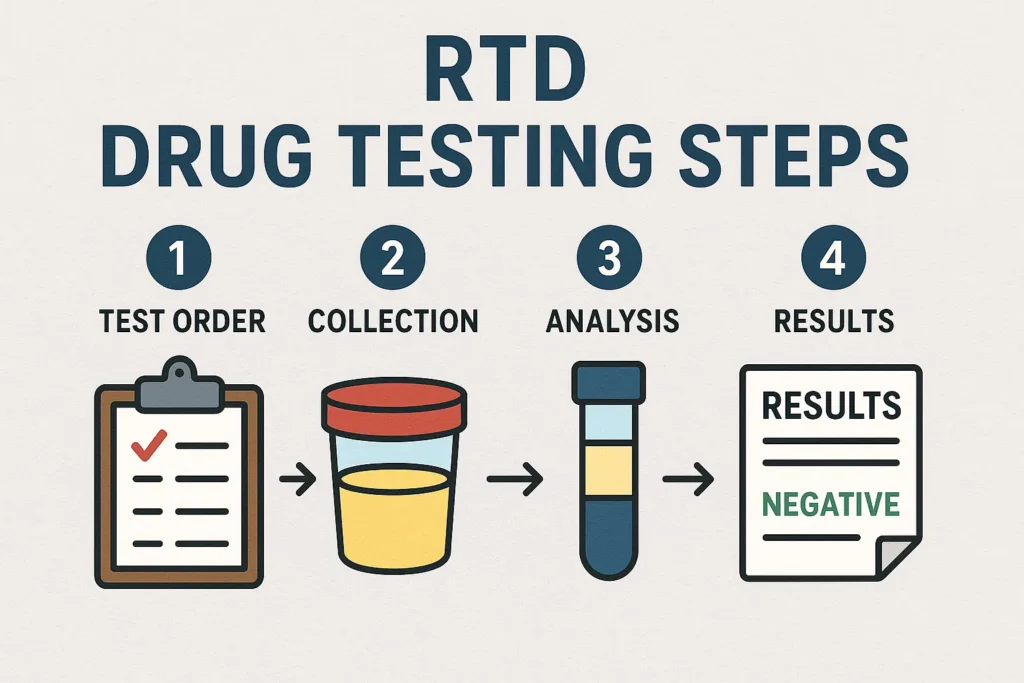
Step 1: Initial Consultation & Federal Paperwork (Same Day)
Your RTD process begins with completing federal DOT paperwork and arranging payment. Professional RTD coordination services handle this critical first step, ensuring forms meet all federal requirements. The consultation includes:
- Thorough review of your SAP documentation for completeness
- Explanation of Georgia-specific testing procedures and requirements
- Selection from 150+ convenient Georgia testing locations
- Strategic scheduling to minimize work and income disruption
Step 2: Testing Location Selection (Within 24 Hours)
Georgia offers numerous DOT-approved testing locations, but strategic selection is crucial for timely completion. Location selection considers:
- Proximity to your home base or current route
- Same-day appointment availability
- Traffic patterns (especially critical in Atlanta metro area)
- Rapid result processing capabilities
Major Georgia Testing Areas:
- Atlanta Metro: Multiple locations serving the Southeast’s logistics capital
- Savannah/Port Area: Convenient to port operations and coastal routes
- Columbus: Serving west Georgia and Alabama border traffic
- Macon: Central Georgia’s crossroads at I-75/I-16 intersection
- Augusta: Eastern Georgia and South Carolina corridor
- Valdosta: Southern gateway to Florida markets
Step 3: The Testing Day (2-3 Hours)
Federal regulations require all RTD tests to be conducted under direct observation. This means a same-gender observer will be present during sample collection. Georgia testing facilities follow strict protocols:
- Bring valid government-issued photo ID and SAP documentation
- Arrive well-hydrated but avoid excessive fluids
- Expect 1-2 hours at the facility including paperwork
- Direct observation procedures will be explained thoroughly
- Chain of custody forms must be completed precisely
Step 4: Results Processing and Clearinghouse Updates (24-48 Hours)
Once your negative RTD test result is confirmed, the critical final steps begin:
- Laboratory Processing: Negative results typically available within 24-48 hours
- Employer Notification: Results sent directly to your employer or C/TPA
- Clearinghouse Reporting: Employers must report negative RTD results to the FMCSA Clearinghouse within 3 business days
- Status Update: Your Clearinghouse status changes from “prohibited” to “not prohibited”
Post-RTD Follow-Up Testing Requirements
Completing your RTD test is just the beginning. Georgia drivers must comply with SAP-prescribed follow-up testing for up to 5 years:
- Minimum 6 unannounced tests in the first 12 months
- All follow-up tests are directly observed
- Testing frequency determined by your SAP (can exceed minimums)
- Follow-up requirements transfer with you between employers
- Any positive result restarts the entire SAP/RTD process
Georgia RTD Costs and Timeline: What to Really Expect
True Cost Breakdown: Georgia Edition
Understanding the real costs of RTD in Georgia helps you budget effectively and avoid financial surprises:
Professional RTD Coordination: $165
- Complete federal paperwork preparation
- Georgia testing location coordination
- Direct submission to employers/C/TPAs
- Clearinghouse update tracking
- 48-hour scheduling guarantee
Hidden Costs of DIY Approaches:
Do not attempt! DOT regulations prohibit drivers from ordering their own RTD test. Even though you may find a testing site to take your hard earned money, the test will not be valid. You will have wasted time and money
- Documentation errors: $200-500 in retest fees
- Scheduling delays: $275+ per day in lost Georgia wages
- Clearinghouse reporting issues: Extended prohibition status
- Travel to distant locations: Gas, time, potential lodging
SAP-Related Costs (Separate from RTD):
- Initial SAP evaluation: $350-600 in Georgia
- Treatment/education programs: $500-2,500+
- Follow-up SAP evaluation: $200-400
- Follow-up testing (6+ tests): $65-85 per test
Realistic Timelines for Georgia Drivers
With Professional RTD Coordination:
- Day 1: Submit Driver & SAP info, sign TPA agreement, make payment, complete one time re-register in Clearinghouse as owner/operator
- Day 1-3 Receive requested SAP Follow up Evaluation Report and type of RTD test required by SAP, drug, alcohol or both. Receive email with testing order to be taken to a site near you.
- Day 1-4: Complete RTD test
- Day 2-6: Receive negative results from MRO and enter in the Clearinghouse. You are now at the beginning of Step 6 on your Clearinghouse Dashboard, no longer prohibited to operate a CMV and under a follow up testing plan.
Common DIY Timeline Delays:
- Do not attempt! DOT regulations prohibit drivers from ordering their own RTD test. Even though you may find a testing site to take your hard earned money, the test will not be valid. You will have wasted time and money
Other Not So Common Timeline Delays May Include:
- SAP not responding to request for documents
- Prescription medication needing to be verified by Medical Review Officer (MRO)
- Incomplete, incorrect or missing Control & Compliance Forms (CCF) from testing site
- State DMV records conflicting with Clearinghouse records
Georgia-Specific RTD Pitfalls That Cost Drivers Thousands
The Atlanta Traffic Trap
Atlanta’s notorious traffic can turn a simple testing appointment into a missed opportunity. Professional coordination considers:
- Rush hour patterns on I-285, I-75, and I-85
- Alternative testing locations outside high-traffic zones
- Appointment scheduling that avoids peak congestion
- Mobile testing options for drivers with tight schedules
Rural Georgia Testing Challenges
Drivers based in rural Georgia face unique obstacles:
- Limited testing locations in small towns
- Longer travel distances to approved facilities
- Less frequent testing appointments available
- Need for advance scheduling and planning
Solution: Professional services maintain relationships with testing networks statewide, including mobile collectors who can meet drivers at truck stops or terminals.
Employer Clearinghouse Reporting Failures
The most critical step often gets overlooked: ensuring your employer properly reports your negative RTD result to the Clearinghouse. Common failures include:
- Employers unfamiliar with reporting requirements
- C/TPA communication breakdowns
- Incorrect data entry causing status errors
- Delays that extend your prohibition period unnecessarily
Professional Protection: RTD coordination services follow up directly with employers and monitor Clearinghouse updates to ensure proper reporting within the required 3-business-day window.
Follow-Up Testing Compliance Disasters
Missing even one follow-up test restarts your entire SAP/RTD process. Georgia-specific challenges include:
- Changing employers who don’t understand transferred requirements
- Confusion about testing frequency and duration
- Failure to maintain required documentation
- Not understanding that follow-up tests are also directly observed
The November 2024 CDL Downgrade Emergency
Georgia’s Department of Driver Services began implementing the federal mandate requiring CDL downgrades for drivers in “prohibited” status. This means:
- Automatic license downgrade without completed RTD
- Loss of all commercial driving privileges
- Additional reinstatement requirements beyond RTD completion
- Potential employment termination due to invalid CDL
Urgent Action Required: Complete your RTD process immediately to change your Clearinghouse status before facing license downgrade.
Getting Back on Georgia’s Roads: Your Action Plan
Immediate Employment Opportunities
Once your Clearinghouse status shows “not prohibited,” Georgia’s thriving freight economy offers immediate opportunities:
High-Demand Georgia Freight Corridors:
- Port of Savannah operations: Container drayage and intermodal opportunities
- Atlanta distribution centers: Major hubs for Amazon, Home Depot, UPS
- Agricultural transport: Seasonal opportunities throughout South Georgia
- Construction materials: Booming Atlanta metro development
- Cross-border routes: Florida produce and southeastern freight
Georgia Industry Opportunities:
- Logistics and warehousing: 24/7 operations in major metro areas
- Manufacturing: Automotive, aerospace, and industrial transport
- Food and beverage: Coca-Cola, poultry, and agricultural products
- Retail distribution: Last-mile delivery and store replenishment
Long-Term Career Protection
Compliance Excellence:
Protect your Georgia CDL career with ongoing compliance:
- Follow-up testing: Never miss a required test—set multiple reminders
- Documentation: Maintain copies of all SAP and testing records
- Employer communication: Ensure each new employer understands your follow-up requirements
- Professional development: Consider additional endorsements (HAZMAT, doubles/triples, tanker)
Building Your Reputation:
- Reliability: Complete follow-up testing without fail
- Communication: Be transparent with employers about your status
- Performance: Excel in your driving duties to rebuild trust
- Networking: Connect with other drivers who’ve successfully completed RTD
Your past violation doesn’t define your future. Georgia’s highways are calling, and with proper RTD completion, you can get back to supporting your family and building your career in the Southeast’s logistics powerhouse.
The return to duty process doesn’t have to be complicated, expensive, or time-consuming. With professional guidance, strategic planning, and proper understanding of Georgia’s requirements, you can complete your RTD quickly and get back to earning your living on Georgia’s roads.
Ready to get back behind the wheel? Don’t let another day of lost earnings pass by. Professional RTD coordination gets you back on the road faster, cheaper, and with less stress than DIY approaches.
Call or text today for immediate RTD scheduling, or complete our online form to get started within 24 hours. With 35+ years of Georgia experience and a guarantee to get you scheduled within 48 hours of receiving your SAP documents, your return to the road is just a phone call away.
Available statewide from Columbus to Savannah, Atlanta to Valdosta – your Georgia CDL career recovery starts now.
Georgia RTD FAQ
What is Return-to-Duty (RTD) testing for Georgia CDL drivers?
RTD testing is the federally required process a CDL driver must complete after a DOT drug or alcohol violation. In Georgia, this includes a SAP evaluation, compliance with the SAP’s treatment recommendations, a directly observed RTD test with negative results, and mandatory follow-up testing for up to 5 years.
How strictly does Georgia enforce federal DOT drug testing regulations?
Georgia strictly enforces federal DOT regulations (49 CFR Parts 40 and 382) for all CDL holders. State law enforcement has direct Clearinghouse access and regularly verifies compliance during roadside inspections, with violations resulting in immediate out-of-service orders.
How long does the RTD process take in Georgia?
If your SAP has cleared you as eligible, professional RTD services can typically schedule and complete your test within 2-4 business days. Employers then have 3 business days to report results to the Clearinghouse, meaning total completion in under a week with proper coordination.
What documents do I need for RTD testing in Georgia?
You’ll need your SAP compliance letter confirming treatment completion, valid government-issued photo ID, employer or C/TPA contact information, and any employer-specific forms. Ensure your FMCSA Clearinghouse account is active and your SAP has reported your eligibility status.
Are all RTD and follow-up tests directly observed in Georgia?
Yes. DOT regulations require both the RTD test and all follow-up tests to be conducted under direct observation, meaning a same-gender observer will be present during collection.
Where can I take an RTD test in Georgia?
Georgia has 150+ DOT-approved collection sites, with concentrations in Atlanta, Savannah, Columbus, Macon, Augusta, and Valdosta. Rural areas have fewer options but mobile collection services are available for remote locations or tight schedules.
What happens if I miss a follow-up test in Georgia?
Missing any follow-up test is considered a violation that requires you to restart the entire SAP/RTD process. Your Clearinghouse status returns to “prohibited” and you’ll face immediate removal from safety-sensitive duties.
How many follow-up tests are required after completing RTD?
Your SAP determines the exact plan, but DOT requires a minimum of 6 unannounced, directly observed tests in the first 12 months. Plans can extend up to 60 months and follow you between employers.
How do Georgia’s CDL downgrade rules affect my RTD timeline?
Since November 2024, Georgia downgrades CDLs for drivers with “prohibited” Clearinghouse status. Complete your RTD to change your status to “not prohibited,” then follow Georgia DDS procedures for license reinstatement. Acting quickly prevents additional licensing complications.
Can I handle the RTD process myself or should I use a professional service?
No you cannot get a Return to Duty Test on your own. The RTD test must be ordered by a DOT registered employer or a C/TPA. Some drivers have found testing facilities to give them an RTD test without an order, only to find out later it was not valid. Only an employer or C/TPA can enter the negative results in the Clearinghouse. The testing facility or the MRO cannot enter the negative results in the Clearinghouse. However, if you test positive, the MRO will enter the new violation in the Clearinghouse.
Official Resources:
DOT Office of Drug & Alcohol Policy & Compliance |
FMCSA Drug & Alcohol Clearinghouse
