Your CDL career in Alabama hangs in the balance. One failed drug test has put you in Clearinghouse limbo, and every day you’re not driving costs you $300+ in lost earnings. But here’s what most Yellowhammer State drivers don’t know: the return to duty process doesn’t have to be a maze of confusion and costly delays.
With over 36,700 heavy and tractor-trailer truck drivers operating across Alabama’s critical transportation network—from the Port of Mobile handling 563,000+ TEUs annually to the I-65 automotive corridor connecting Birmingham to Mercedes-Benz, Honda, and Hyundai manufacturing plants—Alabama drivers are essential to the Southeast’s supply chain. When a positive drug test threatens your CDL career, knowing the exact steps to get back behind the wheel quickly and compliantly can mean the difference between financial disaster and career recovery.
The stakes couldn’t be higher. As of November 18, 2024, new federal regulations mean that drivers with “prohibited” status in the DOT Clearinghouse will have their CDL automatically downgraded by the Alabama Law Enforcement Agency (ALEA). According to the Alabama Trucking Association, approximately 1,400 to 2,000 CDL holders in Alabama face this downgrade procedure, with over 180,000 CDL holders nationwide currently in “prohibited” status as of early 2025. Time is running out for drivers to complete their return to duty process.
This comprehensive guide cuts through the confusion with insider knowledge from 35+ years of helping Alabama drivers with their RTD Testing needs. You’ll discover the exact steps, avoid costly mistakes, understand Alabama’s unique transportation landscape, and get back to earning your living on the Yellowhammer State’s highways.
Why Alabama RTD is Different from Other States
Alabama’s return to duty landscape presents unique opportunities and challenges that drivers in other states may not face. The state’s strategic position on the Gulf Coast and its diverse freight economy create both urgency and opportunity for drivers completing the RTD process.
Alabama’s Strategic Gulf Coast Position Creates Urgency
Alabama sits at the crossroads of America’s Gulf Coast freight network. The Port of Mobile—Alabama’s only deep-water port—is one of the fastest-growing container terminals in the United States<, handling over 55 million tons of cargo annually and generating $98.3 billion in economic impact for the state. With five Class I railroads and direct interstate highway access via I-10 and I-65, the Port serves all 67 Alabama counties and employs one in seven Alabama workers.
This freight volume translates to immediate earning opportunities for drivers who can get back on the road quickly. Every day you’re sidelined means missing out on lucrative port drayage, automotive supply runs, and cross-country routes through Alabama’s interstate network.
Alabama’s Highway Network: The Backbone of Southern Commerce
Alabama’s highway system is a freight powerhouse, with approximately 81.7% of all manufactured tonnage in the state moving by truck—equivalent to roughly 161,180 tons transported daily. The state’s major corridors include:
- I-65: The primary north-south artery spanning 367 miles from Mobile through Montgomery, Birmingham, Decatur, and Huntsville to the Tennessee border—the longest Interstate in Alabama
- I-10: The vital east-west Gulf Coast corridor connecting Florida to Mississippi, essential for coastal freight transport
- I-20/I-59: Critical east-west and diagonal routes linking Birmingham to Atlanta and Mississippi, vital for cross-state manufacturing supply chains
- I-85: Southeast route connecting Montgomery to Georgia, essential for automotive logistics
- I-22: Direct route connecting Birmingham to Memphis, supporting Mid-South freight movement
- I-165: Spur route connecting I-65 to downtown Mobile and Port facilities
Automotive Manufacturing Powerhouse
Alabama has transformed into one of America’s leading automotive manufacturing centers. Assembly plants operated by Mercedes-Benz (Tuscaloosa), Honda (Lincoln), Hyundai (Montgomery), and Mazda-Toyota (Huntsville) have a combined annual production capacity exceeding 1.3 million vehicles. With Toyota, Honda, and Hyundai also producing over 1.5 million engines annually, Alabama ranks in the Top 5 nationally for automotive production and No. 2 for auto exports.
This automotive powerhouse depends heavily on CDL drivers for just-in-time delivery of parts and finished vehicle transport. Drivers who complete RTD quickly can tap into these high-demand, well-paying routes serving the “Auto Alley” corridor along I-65.
ALEA Clearinghouse Integration
The Alabama Law Enforcement Agency (ALEA) is fully integrated with the FMCSA Clearinghouse system. According to ALEA, drivers with a prohibited status are automatically flagged, and commercial driving privileges will be removed until the return to duty process is completed. The good news: once your Clearinghouse status changes to “not prohibited,” ALEA is automatically notified—no additional paperwork required on your end.
Your Step-by-Step Alabama Return to Duty Roadmap
Navigating Alabama’s return to duty process successfully requires understanding both federal requirements and state-specific considerations. Here’s your complete roadmap to getting back behind the wheel.
Pre-RTD Requirements: Getting Your Documentation Ready
Before you can begin return to duty testing, you must complete all Substance Abuse Professional (SAP) requirements. This means:
SAP Evaluation and Treatment Completion: Your SAP must provide documentation confirming you’ve completed all required education or treatment programs. This isn’t just a certificate—it’s detailed paperwork that meets federal DOT standards under 49 CFR Part 40.
Alabama-Specific Documentation: While the federal process is standardized, Alabama’s employment landscape requires attention to detail. Ensure all documentation includes:
- Complete SAP evaluation reports
- Treatment completion certificates
- Return to duty recommendations
- Follow-up testing protocols
Payment Preparation: Professional RTD Testing services in Alabama cost $165 for comprehensive coordination—a small investment to ensure your test is valid and properly reported to the Clearinghouse.
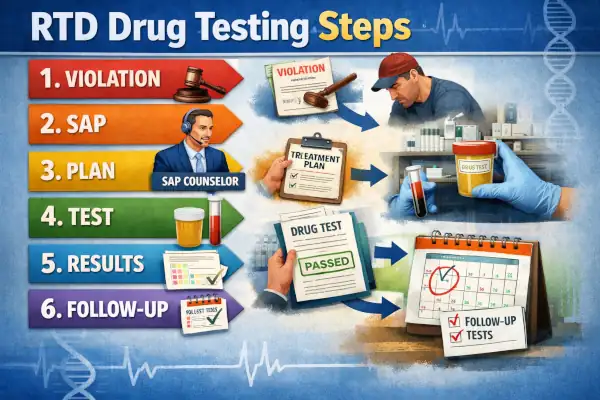
The 6-Step Clearinghouse RTD Process
The return-to-duty process involves the driver and employer working with a Substance Abuse Professional (SAP) to clear a violation through the FMCSA Clearinghouse. Here are the 6 steps:
Step 1: Driver Violation Occurs
A CDL driver tests positive for drugs/alcohol or refuses a test, creating a violation record in the Clearinghouse. This violation places the driver in “prohibited” status, meaning they cannot perform safety-sensitive functions until the RTD process is complete.
Step 2: Driver Connects with a SAP
The driver must contact a Substance Abuse Professional (SAP)—a DOT-certified expert—for evaluation and education. The SAP will assess your situation and determine what treatment or education you need. This step is required before any RTD Testing can occur. The national average SAP fee in 2025 is approximately $500, with some variation based on location and services included.
Step 3: SAP Makes Recommendations & Driver Completes Program
The SAP prescribes a treatment and/or education plan, which the driver must complete. This may include:
- Education programs about substance abuse
- Treatment programs (outpatient or inpatient)
- Counseling sessions
- Other requirements based on your specific situation
Once completed, the SAP will clear you to proceed to RTD Testing (Step 4 in the Clearinghouse).
Step 4: Negative Return-to-Duty (RTD) Test
After completing the SAP’s plan, the driver takes and must pass a negative DOT RTD drug/alcohol test. This is where our $165 RTD Testing service comes in. We coordinate:
- Selection of convenient Alabama testing locations
- Scheduling your directly observed RTD test
- All required DOT paperwork and compliance documentation
- Communication with testing facilities statewide
Major Alabama Testing Areas Covered:
- Birmingham Metro: Multiple locations serving Jefferson, Shelby, and surrounding counties—the state’s largest metropolitan area
- Mobile/Gulf Coast: Convenient to Port of Mobile operations and Baldwin County
- Montgomery: Serving the capital city, Hyundai plant workers, and surrounding counties
- Huntsville/Decatur: Covering Madison County, the Mazda-Toyota plant area, and North Alabama logistics hubs
- Tuscaloosa: Serving Mercedes-Benz plant workers and West Alabama
- Dothan: Southeast Alabama agricultural and logistics hub
- Anniston/Gadsden: Honda plant area and Northeast Alabama
Step 5: Results Entered into Clearinghouse
Once you have a negative RTD test result, your employer or C/TPA (Consortium/Third Party Administrator) must report the results to the FMCSA Clearinghouse within 3 business days. Once reported, you are no longer prohibited from performing safety-sensitive functions and CAN return to driving. This is the critical step where professional TPA services ensure same-day Clearinghouse reporting.
Step 6: Follow-Up Testing Plan Completed
The driver operates under the SAP’s follow-up testing plan (minimum 6 unannounced tests in first 12 months, can extend up to 60 months). Step 6 is closed when the final follow-up test is completed and entered in the Clearinghouse, typically 1-5 years after the driver returns to work.
CRITICAL DISTINCTION: You can return to work after Step 5 (after negative RTD test). Step 6 remains open while you work under your follow-up testing plan.
Alabama Cannabis Laws and CDL Compliance
Alabama’s cannabis laws create important considerations for CDL drivers navigating the return to duty process.
Current Alabama Cannabis Status:
Alabama legalized medical marijuana in 2021 through the Darren Wesley “Ato” Hall Compassion Act. However, recreational marijuana remains illegal in the state, and as of early 2025, licensed dispensaries have not yet begun operations due to ongoing regulatory processes.
Critical Federal Override for CDL Drivers:
Regardless of Alabama’s medical marijuana program, federal DOT regulations strictly prohibit marijuana use for all CDL holders. The DOT has clearly stated: “It remains unacceptable for any safety-sensitive employee subject to drug testing under the Department of Transportation’s drug testing regulations to use marijuana.”
This means:
- A valid Alabama medical marijuana card does NOT protect you from DOT drug testing consequences
- A positive marijuana test will result in a violation regardless of your medical status
- CBD products are used at your own risk—some contain THC levels that can cause positive tests
- Alabama employers can test for marijuana and take adverse action even for medical cardholders
Alabama’s Drug-Free Workplace Provisions:
Under Alabama Code § 25-5-334, employers maintaining drug-free workplace programs receive workers’ compensation premium discounts. This means most Alabama trucking employers will continue strict drug testing policies regardless of state medical marijuana laws. The Compassion Act specifically allows employers to refuse to hire, terminate, or discipline employees who test positive for marijuana, even with a valid medical card.
Alabama RTD Cost Breakdown: What to Expect
Understanding the full financial picture helps you plan effectively and avoid surprises. Here’s what Alabama drivers typically face:
| Service | Typical Cost Range | Notes |
|---|---|---|
| SAP Initial Evaluation | $350-$600 | National average ~$500; some include follow-up evaluation |
| SAP Follow-Up Evaluation | $0-$200 | Often included in initial fee—ask upfront |
| Education/Treatment Program | $500-$2,500+ | Varies based on SAP recommendations |
| Professional TPA/RTD Service | $165 | All coordination, paperwork, Clearinghouse reporting |
| Testing Facility Fee | $65-$85 | Paid directly to collection site |
| Total Estimated Range | $815-$3,045+ | Depends on treatment requirements |
Hidden Costs of DIY Approaches:
Do not attempt! DOT regulations prohibit drivers from ordering their own RTD test. Even though you may find a testing site to take your hard-earned money, the test will not be valid. You will have wasted time and money.
Additional risks of going it alone:
- Documentation errors: $200-500 in retest fees
- Scheduling delays: $300+ per day in lost Alabama wages
- Clearinghouse reporting issues: Extended prohibition status
- Travel to distant locations: Gas, time, potential lodging
Can You Appeal the SAP’s Decision?
No, you cannot appeal a SAP’s decision. Once the SAP plan/recommendations are given to the driver, only the SAP can change those recommendations. Second SAP opinions are prohibited. See: 49 CFR Part 40, § 40.295.
Alabama RTD Timeline: What’s Realistic
Understanding realistic timelines helps you plan your career recovery:
| Phase | Typical Duration | Variables |
|---|---|---|
| SAP Evaluation | 1-3 days | SAP availability in your area |
| Education/Treatment | 1 week – 3+ months | Based on SAP recommendation |
| SAP Follow-Up Evaluation | 1-3 days | After treatment completion |
| RTD Test Scheduling | 24-48 hours | With professional TPA service |
| Lab Results | 24-72 hours | Negative results reported faster |
| Clearinghouse Update | Same day – 3 business days | Professional service = same day |
Best Case Scenario: If your SAP has already cleared you as eligible (Step 4 in the Clearinghouse), scheduling and completing the observed RTD test plus Clearinghouse reporting can often be finished within 3-7 business days—assuming no paperwork or lab delays.
Worst Case Scenario: Drivers requiring extensive treatment may face 3-6 months before reaching the RTD testing phase.
Getting Hired After RTD in Alabama: Employment Recovery
Completing your RTD test is just the beginning. Here’s how to rebuild your Alabama trucking career:
Alabama’s Trucking Job Market:
Alabama’s trucking industry paid over $7.2 billion in wages in 2022, with the median salary for truck drivers around $50,120—and significant opportunity for higher earnings with experience. Heavy and tractor-trailer truck drivers consistently rank among the state’s most in-demand occupations, with hundreds of job openings posted monthly.
Industries Actively Hiring in Alabama:
- Automotive Supply Chain: Mercedes-Benz, Honda, Hyundai, Mazda-Toyota, and 200+ Tier 1 and Tier 2 suppliers need reliable drivers for just-in-time delivery
- Port Drayage: Port of Mobile’s container operations create steady demand for local and regional drivers
- Agricultural Transport: Cotton, poultry, peanuts, and timber products throughout rural Alabama
- Construction Materials: Cement, aggregates, and steel supporting Alabama’s growth
- General Freight: LTL and FTL carriers serving the I-65 and I-10 corridors
Disclosure Strategies:
When applying for jobs after completing RTD:
- Be honest—employers will query the Clearinghouse and see your history
- Emphasize completion—you’ve demonstrated responsibility by finishing the process
- Highlight compliance—you understand DOT requirements better than most drivers
- Focus on the future—your follow-up testing plan shows commitment to maintaining sobriety
Seasonal Alabama Opportunities:
- Holiday freight: November-January peak shipping seasons
- Agricultural cycles: Harvest season demands throughout Alabama’s farming regions
- Hurricane season: Disaster relief and preparation freight surges
- Construction seasons: Spring-fall increased building materials transport
Long-Term Career Protection
Compliance Maintenance:
Protect your career with ongoing compliance:
- Follow-up testing: Complete all required SAP follow-up protocols (minimum 6 tests in first 12 months)
- Regulatory awareness: Stay informed about DOT requirement changes
- Professional development: Consider additional endorsements and certifications
Employment Stability:
Build long-term career security through:
- Employer relationships: Maintain positive relationships with current and former employers
- Professional reputation: Demonstrate reliability and compliance excellence
- Skill development: Continuous improvement in driving skills and industry knowledge
Your past choices don’t define your present. Alabama’s highways are waiting for you, and with proper RTD completion, you can get back to supporting your family and building your career in the Yellowhammer State’s thriving freight economy.
The return to duty process doesn’t have to be complicated, expensive, or time-consuming. With professional RTD Testing guidance, strategic planning, and proper understanding of Alabama’s transportation landscape, you can complete your RTD Testing quickly and get back to earning your living on Alabama’s roads.
Ready to get back behind the wheel? Don’t let another day of lost earnings pass by. Professional RTD Testing coordination gets you back on the road fast with valid, compliant testing that’s properly reported to the Clearinghouse.
Schedule My RTD Test Now or Call/Text (843) 327-4444 for immediate RTD Testing scheduling. With 35+ years of experience and a guarantee to get you scheduled within 48 hours of receiving your SAP documents, your return to the road is just a phone call away.
Available statewide from Mobile to Huntsville, from Birmingham to Dothan—your Alabama CDL career recovery starts now.
Alabama RTD Frequently Asked Questions
What is Return-to-Duty (RTD) testing for Alabama CDL drivers?
RTD testing is the federally required process a CDL driver must complete after a DOT drug or alcohol violation. It includes a Substance Abuse Professional (SAP) evaluation, compliance with the SAP’s recommendations, a directly observed RTD test with a negative result, and follow-up testing. Once you pass the RTD test, your Clearinghouse status changes to “not prohibited” and you can legally drive again.
How does the Alabama ALEA handle Clearinghouse violations?
The Alabama Law Enforcement Agency (ALEA) is fully integrated with the FMCSA Clearinghouse. When you’re placed in prohibited status, ALEA is automatically notified and will downgrade your CDL until you complete the RTD process. According to the Alabama Trucking Association, approximately 1,400-2,000 Alabama CDL holders face this procedure. Once your Clearinghouse status changes to “not prohibited,” ALEA is automatically notified—no documentation needs to be submitted to ALEA on your end.
How long does it take to complete RTD in Alabama?
Timelines vary based on your situation. If your SAP has already cleared you as eligible (Step 4 in the Clearinghouse), scheduling and completing the observed RTD test plus Clearinghouse reporting can often be finished within 3-7 business days—assuming no paperwork or lab delays.
What documents do I need before scheduling my RTD test?
Have your SAP compliance documentation, a valid government ID, employer or C/TPA contact details, and any employer-requested forms. Make sure your FMCSA Clearinghouse account is active and that your SAP has reported your eligibility (Step 4 completion).
Are RTD and follow-up tests directly observed?
Yes. DOT requires the RTD test and all follow-up tests to be directly observed. These are separate from and in addition to random testing. This is a federal requirement under 49 CFR Part 40.
Where can I take an RTD test in Alabama?
There are DOT-collection sites throughout Alabama, including Birmingham, Mobile, Montgomery, Huntsville, Tuscaloosa, Dothan, Anniston, and Gadsden. Professional TPA services have access to over 10,000 testing locations nationwide, ensuring convenient scheduling regardless of your location in Alabama.
What happens in the FMCSA Clearinghouse after a negative RTD result?
Your employer or C/TPA reports the negative RTD result to the FMCSA Clearinghouse within 3 business days. Once posted, your status changes from “prohibited” to “not prohibited,” restoring your eligibility to perform safety-sensitive functions. ALEA is automatically notified of this change.
How many follow-up tests are required after RTD?
The SAP sets the follow-up testing plan. DOT requires a minimum of six unannounced, directly observed tests in the first 12 months, and the plan can extend up to 60 months. This follow-up testing plan follows you between employers.
What do the November 2024 CDL downgrade rules mean for Alabama drivers?
As of November 18, 2024, ALEA must downgrade or disqualify a driver with a “prohibited” Clearinghouse status. To reinstate commercial privileges, you must complete the RTD process so your status becomes “not prohibited.” ALEA will then automatically allow reinstatement of your CDL.
Can I order my own RTD test?
No. DOT regulations prohibit drivers from ordering their own RTD test. Even if a testing site takes your money, the test will not be valid and won’t count toward your return to duty process. All RTD tests and follow-up tests must be ordered by an employer or a Consortium/Third Party Administrator (C/TPA). Owner-operators and independent drivers must work with a C/TPA like our professional RTD Testing service to ensure valid, compliant testing.
How much does RTD Testing cost in Alabama?
Professional RTD Testing services cost $165, which includes all coordination, paperwork, and Clearinghouse reporting. The testing facility fee is additional (typically $50-80). Remember: DOT regulations prohibit drivers from ordering their own RTD test—all tests must be ordered by an employer or C/TPA to be valid.
What if I’m an owner-operator without an employer?
Owner-operators need a Consortium/Third Party Administrator (C/TPA) to manage their RTD Testing, as federal regulations require a third party to order and report the test results. Professional RTD Testing services fulfill this requirement and handle all Clearinghouse reporting on your behalf.
Does Alabama’s medical marijuana law protect CDL drivers?
No. While Alabama legalized medical marijuana in 2021, federal DOT regulations strictly prohibit marijuana use for all safety-sensitive employees, including CDL drivers. A valid Alabama medical marijuana card does NOT protect you from DOT drug testing consequences. A positive marijuana test will result in a violation regardless of your state medical status.
More official guidance: DOT ODAPC | FMCSA Clearinghouse | Alabama ALEA CDL Information

One Response