Your CDL career in North Carolina hangs in the balance. One failed drug test has put you in Clearinghouse limbo, and every day you’re not driving costs you $300+ in lost earnings. But here’s what most Tar Heel State drivers don’t know: the return to duty process doesn’t have to be a maze of confusion and costly delays.
With over 65,000 heavy and tractor-trailer truck drivers operating across North Carolina’s critical transportation network—from the Port of Wilmington handling 330,000+ TEUs annually to the I-85 automotive corridor connecting Charlotte to major manufacturing hubs—North Carolina drivers are essential to the Southeast’s supply chain. When a positive drug test threatens your CDL career, knowing the exact steps to get back behind the wheel quickly and compliantly can mean the difference between financial disaster and career recovery.
The stakes couldn’t be higher. As of November 18, 2024, new federal regulations mean that drivers with “prohibited” status in the DOT Clearinghouse will have their CDL automatically downgraded by the North Carolina Division of Motor Vehicles. With over 180,000 CDL holders nationwide currently in “prohibited” status as of early 2025, time is running out for drivers to complete their return to duty process.
This comprehensive guide cuts through the confusion with insider knowledge from 35+ years of helping North Carolina drivers with their RTD Testing needs. You’ll discover the exact steps, avoid costly mistakes, understand North Carolina’s unique transportation landscape, and get back to earning your living on the Tar Heel State’s highways.
Why North Carolina RTD is Different from Other States
North Carolina’s return to duty landscape presents unique opportunities and challenges that drivers in other states may not face. The state’s strategic position on the East Coast and its diverse freight economy create both urgency and opportunity for drivers completing the RTD process.
North Carolina’s Strategic East Coast Position Creates Urgency
North Carolina sits at the crossroads of America’s East Coast freight network. The Port of Wilmington ranks as the most productive port in North America, with truck turnaround times averaging just 18 minutes for single moves—the fastest on the East Coast. The Charlotte Inland Port serves as a critical intermodal hub connecting the I-85 and I-77 corridors to international shipping lanes.
This freight volume translates to immediate earning opportunities for drivers who can get back on the road quickly. Every day you’re sidelined means missing out on lucrative port drayage, manufacturing supply runs, and cross-country routes through North Carolina’s interstate network.
North Carolina’s Highway Network: The Backbone of East Coast Commerce
North Carolina’s highway system is a freight powerhouse, with approximately 86% of all freight tonnage in the state moving by truck. The state’s major corridors include:
- I-95: The primary north-south artery connecting Florida to New England, passing through Fayetteville and the eastern part of the state
- I-85: The automotive manufacturing corridor linking Charlotte to Atlanta and beyond, supporting the region’s booming auto industry
- I-40: East-west connectivity from the Port of Wilmington through Raleigh-Durham to Asheville and into Tennessee
- I-77: Northern route connecting Charlotte to Virginia and the Midwest markets
- I-26: Western corridor linking Asheville to Tennessee and the Southeast
Manufacturing and Distribution Hub
North Carolina has transformed into a major manufacturing and distribution center, with approximately 18,100 active interstate motor-carrier companies listing North Carolina as their principal place of business. From the Research Triangle’s tech corridor to Charlotte’s financial district, from the furniture manufacturing hub of the Piedmont Triad to the agricultural regions of eastern North Carolina, drivers who complete RTD quickly can tap into diverse freight opportunities year-round.
NCDMV Clearinghouse Integration
The North Carolina Division of Motor Vehicles is fully integrated with the FMCSA Clearinghouse system. According to the NCDMV, drivers with a prohibited status are automatically flagged, and commercial driving privileges will be removed until the return to duty process is completed. The good news: once your Clearinghouse status changes to “not prohibited,” the NCDMV is automatically notified—no additional paperwork required on your end.
Your Step-by-Step North Carolina Return to Duty Roadmap
Navigating North Carolina’s return to duty process successfully requires understanding both federal requirements and state-specific considerations. Here’s your complete roadmap to getting back behind the wheel.
Pre-RTD Requirements: Getting Your Documentation Ready
Before you can begin return to duty testing, you must complete all Substance Abuse Professional (SAP) requirements. This means:
SAP Evaluation and Treatment Completion: Your SAP must provide documentation confirming you’ve completed all required education or treatment programs. This isn’t just a certificate—it’s detailed paperwork that meets federal DOT standards under 49 CFR Part 40.
North Carolina-Specific Documentation: While the federal process is standardized, North Carolina’s employment landscape requires attention to detail. Ensure all documentation includes:
- Complete SAP evaluation reports
- Treatment completion certificates
- Return to duty recommendations
- Follow-up testing protocols
Payment Preparation: Professional RTD Testing services in North Carolina cost $165 for comprehensive coordination—a small investment to ensure your test is valid and properly reported to the Clearinghouse.
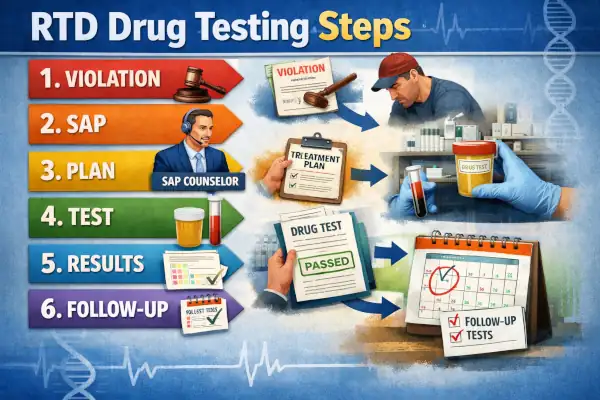
The 6-Step Clearinghouse RTD Process
The return-to-duty process involves the driver and employer working with a Substance Abuse Professional (SAP) to clear a violation through the FMCSA Clearinghouse. Here are the 6 steps:
Step 1: Driver Violation Occurs
A CDL driver tests positive for drugs/alcohol or refuses a test, creating a violation record in the Clearinghouse. This violation places the driver in “prohibited” status, meaning they cannot perform safety-sensitive functions until the RTD process is complete.
Step 2: Driver Connects with a SAP
The driver must contact a Substance Abuse Professional (SAP)—a DOT-certified expert—for evaluation and education. The SAP will assess your situation and determine what treatment or education you need. This step is required before any RTD Testing can occur.
Step 3: SAP Makes Recommendations & Driver Completes Program
The SAP prescribes a treatment and/or education plan, which the driver must complete. This may include:
- Education programs about substance abuse
- Treatment programs (outpatient or inpatient)
- Counseling sessions
- Other requirements based on your specific situation
Once completed, the SAP will clear you to proceed to RTD Testing (Step 4 in the Clearinghouse).
Step 4: Negative Return-to-Duty (RTD) Test
After completing the SAP’s plan, the driver takes and must pass a negative DOT RTD drug/alcohol test. This is where our $165 RTD Testing service comes in. We coordinate:
- Selection of convenient North Carolina testing locations
- Scheduling your directly observed RTD test
- All required DOT paperwork and compliance documentation
- Communication with testing facilities statewide
Major North Carolina Testing Areas Covered:
- Charlotte Metro: Multiple locations serving the Queen City and surrounding Mecklenburg, Union, and Gaston counties
- Raleigh-Durham-Chapel Hill (Research Triangle): Convenient to Wake, Durham, and Orange counties
- Piedmont Triad: Serving Greensboro, Winston-Salem, and High Point metro areas
- Wilmington Port Area: Locations near the Port of Wilmington and coastal freight operations
- Fayetteville: Serving the I-95 corridor and Cumberland County
- Asheville: Western North Carolina mountain region coverage
Step 5: Employer Reports RTD Information
The employer (or C/TPA like our service) reports the negative RTD test result and the completion of the RTD process into the Clearinghouse. This immediate processing means:
- Compliance Restoration: Your prohibited status is removed from the DOT Clearinghouse
- Employment Eligibility: You can immediately begin applying for driving positions
- NCDMV Notification: The North Carolina DMV is automatically notified of your status change
Step 6: Follow-Up Testing & Record Completion
The driver completes the SAP-mandated follow-up testing schedule. Key points:
- Minimum of 6 unannounced, directly observed tests in the first 12 months
- Follow-up testing can extend up to 60 months based on SAP recommendations
- Individual follow-up tests are not reported separately to the Clearinghouse
- After the 5-year period ends, the violation record is cleared from the Clearinghouse
After RTD: Getting Back to Work in North Carolina
Immediate Next Steps:
With your Clearinghouse status restored, you can immediately:
- Apply for driving positions with confidence
- Provide employers with proof of RTD completion
- Resume commercial driving operations
North Carolina Job Market Advantages:
North Carolina’s diverse freight economy provides numerous opportunities:
- Port Drayage: The Port of Wilmington’s rapid growth creates steady demand for container and breakbulk hauling
- Manufacturing Supply Chains: Automotive, furniture, and tech manufacturing require reliable transportation
- Cross-Country Routes: North Carolina serves as a critical hub for I-95 and I-85 freight corridors
- Local Distribution: The state’s population of over 10 million requires extensive local delivery networks
Finding RTD Testing Locations in the Tar Heel State
North Carolina’s geographic diversity requires strategic testing location selection to minimize travel time and maximize convenience. Our professional RTD Testing service helps you find the right location for smooth completion.
Major Metropolitan Coverage Areas
Charlotte Metro Area
As North Carolina’s largest city and a major financial and distribution hub, Charlotte offers excellent RTD testing coverage. Testing locations serve:
- Uptown Charlotte: Convenient to I-77 and I-85 interchange
- Charlotte Inland Port vicinity: Ideal for intermodal and port drayage drivers
- Surrounding counties: Mecklenburg, Union, Cabarrus, Gaston, and Iredell
Research Triangle (Raleigh-Durham-Chapel Hill)
The Triangle’s tech-driven economy creates unique logistics demands:
- Raleigh vicinity: Wake County’s central location serves eastern North Carolina
- Durham area: Convenient to I-85 and I-40 corridors
- RTP connections: Serving biotech and pharmaceutical distribution networks
Piedmont Triad (Greensboro-Winston-Salem-High Point)
The furniture and manufacturing hub requires extensive testing coverage:
- Greensboro area: Central Piedmont hub at I-40 and I-85 junction
- Winston-Salem area: Manufacturing and distribution center coverage
- High Point area: Furniture industry logistics hub
Wilmington Port Area
Proximity to North Carolina’s primary deepwater port creates unique opportunities:
- Downtown Wilmington: Quick access to port operations
- I-40 corridor: Connecting port traffic to inland destinations
- New Hanover and Brunswick counties: Coastal freight coverage
Fayetteville and I-95 Corridor
Strategic location for north-south freight movement:
- Cumberland County: Central to I-95 operations
- Military-related freight: Fort Liberty (formerly Fort Bragg) logistics support
- Cross-state routes: I-95 to I-40 connections
Asheville and Western North Carolina
Mountain region coverage for western routes:
- Buncombe County: I-26 and I-40 interchange access
- Tennessee border routes: Cross-mountain freight operations
- Regional distribution: Western NC manufacturing support
Scheduling Strategies for North Carolina Success
Peak Times to Avoid:
- Monday mornings (weekend backlog processing)
- Friday afternoons (potential weekend delays)
- Day-before-holiday periods
- First week of each month (increased testing volume)
Optimal Scheduling:
- Tuesday through Thursday mornings
- Mid-morning appointments (9-11 AM)
- Early afternoon slots (1-3 PM)
- Avoid Charlotte I-77 rush hours if traveling through metro area
North Carolina Traffic Considerations:
- Allow extra travel time for Charlotte and Raleigh metropolitan areas
- Consider I-485 loop for Charlotte-area testing locations
- Plan for construction delays on major freight corridors (I-40, I-85 widening projects)
- Use traffic apps for real-time routing adjustments
Cost Analysis: Professional RTD Testing in North Carolina
Understanding the value of professional RTD Testing services in North Carolina helps you make the right decision for your career recovery.
Professional RTD Testing Service Value Breakdown
$165 All-Inclusive Professional RTD Testing Service Includes:
- Complete DOT paperwork preparation and filing
- Strategic testing location selection
- Appointment scheduling and coordination
- Direct communication with testing facilities
- Immediate Clearinghouse result processing
- Expert guidance throughout the entire process
- 35+ years of experience helping drivers nationwide
⚠️ Warning: Do Not Attempt to Order Your Own RTD Test
DOT regulations prohibit drivers from ordering their own RTD test. Even though you may find a testing site willing to take your hard-earned money, the test will not be valid. You will have wasted both time and money.
All RTD tests and follow-up tests must be ordered by an employer or a Consortium/Third Party Administrator (C/TPA). This is a federal requirement under 49 CFR Part 40—there are no exceptions.
If you’re an owner-operator or don’t have an employer to order your test, you need a C/TPA like our professional RTD Testing service to handle the process correctly and ensure your results are valid and properly reported to the Clearinghouse.
ROI Calculation for North Carolina Drivers
Daily Earnings Recovery:
North Carolina CDL drivers average $250-400+ per day depending on:
- Port drayage: $280-380 per day for Wilmington port operations
- Long-haul routes: $250-350 per day for over-the-road operations
- Local delivery: $200-300 per day for regional distribution
- Specialized transport: $350-500+ per day for hazmat, tanker, or oversized loads
Professional RTD Testing Service ROI:
- Cost: $165 one-time professional RTD Testing coordination
- Time savings: Fast, compliant processing vs. invalid self-ordered tests
- Earnings recovery: $300 × 21 days = $6,300+ in additional income
- ROI calculation: 3,200% return on professional service investment
Career Trajectory Protection:
Professional RTD Testing completion protects:
- Employment opportunities: Immediate eligibility for new positions
- Employer preferences: Professional completion demonstrates responsibility
- Insurance considerations: Clean RTD completion may reduce insurance costs
- Future advancement: Proper handling protects long-term career prospects
Avoid These North Carolina-Specific RTD Pitfalls
Learning from common mistakes can save thousands in lost income and prevent dangerous delays that could affect your driving career permanently.
Documentation Errors
Incomplete SAP Paperwork:
North Carolina’s thorough employment verification processes mean incomplete SAP documentation causes immediate delays. Ensure your SAP provides:
- Complete evaluation reports with specific recommendations
- Treatment completion certificates with dates and signatures
- Return to duty recommendations meeting federal DOT standards
- Follow-up testing protocols clearly outlined
Federal vs. State Form Confusion:
Some drivers mistakenly use state employment forms instead of required federal DOT paperwork. RTD testing requires specific federal forms that differ from general employment drug testing paperwork.
Location Selection Mistakes
Choosing Inconvenient Facilities:
North Carolina’s geography can turn poor location selection into an expensive mistake:
- Traffic miscalculations: Underestimating Charlotte or Raleigh travel times during rush hour
- Facility capabilities: Not all testing locations process RTD results immediately
- Appointment availability: Some locations require weeks of advance scheduling
- Processing delays: Facilities without immediate MRO communication cause Clearinghouse delays
Not Verifying DOT Approval:
Some general drug testing facilities cannot process federal DOT return to duty testing. Using incorrect facilities means retesting and additional delays.
Clearinghouse and NCDMV Misunderstandings
Waiting for NCDMV Action:
Some drivers mistakenly believe they need to submit paperwork to the North Carolina DMV after completing RTD. The NCDMV explicitly states: “No documentation will need to be submitted to the NCDMV at any point in the process. Everything is handled through the clearinghouse.”
Misunderstanding Automatic Updates:
Once your RTD test results are entered and your Clearinghouse status changes to “not prohibited,” the NCDMV is automatically notified. Don’t waste time submitting redundant paperwork.
Timeline Miscalculations
November 2024 Deadline Oversight:
The federal requirement that state licensing agencies remove commercial driving privileges from drivers with “prohibited” Clearinghouse status beginning November 18, 2024 is now in full effect. Drivers who delay RTD completion face:
- Automatic CDL downgrade: Loss of commercial driving privileges
- Extended recovery time: Additional requirements to restore full CDL status
- Employment complications: Employers cannot hire drivers without valid CDLs
Expert Tips & Resources for North Carolina RTD Success
Leveraging professional expertise and understanding available resources can dramatically improve your RTD experience and long-term career prospects.
Professional RTD Testing Guidance Benefits
35+ Years Experience Advantage:
Professional RTD Testing coordination provides:
- Regulatory Expertise: Deep understanding of federal DOT requirements and North Carolina DMV procedures
- Facility Relationships: Established connections with testing locations statewide ensure priority scheduling
- Process Efficiency: Streamlined procedures eliminate common delays and mistakes
- Compliance Assurance: Professional oversight ensures complete regulatory compliance
Available Support Includes:
- 24/7 Communication: Available Monday through Sunday, 8:00 AM – 8:00 PM by appointment
- Immediate Response: Questions answered promptly throughout the entire process
- Documentation Review: Expert verification of SAP paperwork before testing
- Troubleshooting: Quick resolution of unexpected complications
North Carolina-Specific Resources
Official Resources:
- NCDMV CDL Drug & Alcohol Clearinghouse Information
- FMCSA Drug & Alcohol Clearinghouse
- DOT Office of Drug & Alcohol Policy & Compliance (ODAPC)
- FMCSA Return-to-Duty Quick Reference Guide
Employment Recovery Strategies
Immediate Post-RTD Actions:
- Update your resume: Include RTD completion date and compliance status
- Clearinghouse access: Provide employers with query consent promptly
- Reference preparation: Contact previous employers to confirm reference availability
- Certification updates: Ensure medical card and other certifications are current
High-Demand Freight Corridors:
Position yourself for opportunities in North Carolina’s busiest freight areas:
- Port of Wilmington: Growing container and intermodal operations with best-in-class turn times
- I-85 Automotive Corridor: Manufacturing supply chain from Charlotte to Virginia
- I-95 North-South: East Coast’s primary freight artery through Fayetteville
- Research Triangle logistics: Tech and pharmaceutical distribution networks
Seasonal Considerations:
North Carolina’s diverse economy creates seasonal opportunities:
- Holiday freight: November-January peak shipping seasons
- Agricultural cycles: Eastern NC farming regions with harvest season demands
- Hurricane season prep: Summer storm preparation creates freight surges
- Construction seasons: Spring-fall increased building materials transport
Long-Term Career Protection
Compliance Maintenance:
Protect your career with ongoing compliance:
- Follow-up testing: Complete any required SAP follow-up protocols (minimum 6 tests in first 12 months)
- Regulatory awareness: Stay informed about DOT requirement changes
- Professional development: Consider additional endorsements and certifications
Employment Stability:
Build long-term career security through:
- Employer relationships: Maintain positive relationships with current and former employers
- Professional reputation: Demonstrate reliability and compliance excellence
- Skill development: Continuous improvement in driving skills and industry knowledge
Your past choices don’t define your present. North Carolina’s highways are waiting for you, and with proper RTD completion, you can get back to supporting your family and building your career in the Tar Heel State’s thriving freight economy.
The return to duty process doesn’t have to be complicated, expensive, or time-consuming. With professional RTD Testing guidance, strategic planning, and proper understanding of North Carolina’s transportation landscape, you can complete your RTD Testing quickly and get back to earning your living on North Carolina’s roads.
Ready to get back behind the wheel? Don’t let another day of lost earnings pass by. Professional RTD Testing coordination gets you back on the road fast with valid, compliant testing that’s properly reported to the Clearinghouse.
Schedule My RTD Test Now or Call/Text (843) 327-4444 for immediate RTD Testing scheduling. With 35+ years of experience and a guarantee to get you scheduled within 48 hours of receiving your SAP documents, your return to the road is just a phone call away.
Available statewide from Asheville to Wilmington, from Charlotte to the Outer Banks — your North Carolina CDL career recovery starts now.
North Carolina RTD Frequently Asked Questions
What is Return-to-Duty (RTD) testing for North Carolina CDL drivers?
RTD testing is the federally required process a CDL driver must complete after a DOT drug or alcohol violation. It includes a Substance Abuse Professional (SAP) evaluation, compliance with the SAP’s recommendations, a directly observed RTD test with a negative result, and follow-up testing. Once you pass the RTD test, your Clearinghouse status changes to “not prohibited” and you can legally drive again.
How does the North Carolina DMV handle Clearinghouse violations?
The NCDMV is fully integrated with the FMCSA Clearinghouse. When you’re placed in prohibited status, the NCDMV is automatically notified and will disqualify your CDL for a minimum of 30 days until you complete the RTD process. No documentation needs to be submitted to the NCDMV—everything is handled through the Clearinghouse.
How long does it take to complete RTD in North Carolina?
Timelines vary based on your situation. If your SAP has already cleared you as eligible (Step 4 in the Clearinghouse), scheduling and completing the observed RTD test plus Clearinghouse reporting can often be finished within 3-7 business days—assuming no paperwork or lab delays.
What documents do I need before scheduling my RTD test?
Have your SAP compliance documentation, a valid government ID, employer or C/TPA contact details, and any employer-requested forms. Make sure your FMCSA Clearinghouse account is active and that your SAP has reported your eligibility (Step 4 completion).
Are RTD and follow-up tests directly observed?
Yes. DOT requires the RTD test and all follow-up tests to be directly observed. These are separate from and in addition to random testing. This is a federal requirement under 49 CFR Part 40.
Where can I take an RTD test in North Carolina?
There are DOT-collection sites throughout the state, including Charlotte, Raleigh-Durham, Greensboro-Winston-Salem, Wilmington, Fayetteville, and Asheville. Professional TPA services have access to over 10,000 testing locations nationwide, ensuring convenient scheduling regardless of your location in North Carolina.
What happens in the FMCSA Clearinghouse after a negative RTD result?
Your employer or C/TPA reports the negative RTD result to the FMCSA Clearinghouse within 3 business days. Once posted, your status changes from “prohibited” to “not prohibited,” restoring your eligibility to perform safety-sensitive functions. The NCDMV is automatically notified of this change.
How many follow-up tests are required after RTD?
The SAP sets the follow-up testing plan. DOT requires a minimum of six unannounced, directly observed tests in the first 12 months, and the plan can extend up to 60 months. This follow-up testing plan follows you between employers.
What do the November 2024 CDL downgrade rules mean for North Carolina drivers?
As of November 18, 2024, the NCDMV must downgrade or disqualify a driver with a “prohibited” Clearinghouse status. To reinstate commercial privileges, you must complete the RTD process so your status becomes “not prohibited.” The NCDMV will then automatically allow reinstatement of your CDL.
Can I order my own RTD test?
No. DOT regulations prohibit drivers from ordering their own RTD test. Even if a testing site takes your money, the test will not be valid and won’t count toward your return to duty process. All RTD tests and follow-up tests must be ordered by an employer or a Consortium/Third Party Administrator (C/TPA). Owner-operators and independent drivers must work with a C/TPA like our professional RTD Testing service to ensure valid, compliant testing.
How much does RTD Testing cost in North Carolina?
Professional RTD Testing services cost $165, which includes all coordination, paperwork, and Clearinghouse reporting. The testing facility fee is additional (typically $50-80). Remember: DOT regulations prohibit drivers from ordering their own RTD test—all tests must be ordered by an employer or C/TPA to be valid.
What if I’m an owner-operator without an employer?
Owner-operators need a Consortium/Third Party Administrator (C/TPA) to manage their RTD Testing, as federal regulations require a third party to order and report the test results. Professional RTD Testing services fulfill this requirement and handle all Clearinghouse reporting on your behalf.
More official guidance: DOT ODAPC | FMCSA Clearinghouse | NCDMV Clearinghouse Info
